

Most residency interviews include a question that starts with “tell me about a time when.” That is a residency interview behavioral questions, and it is not really asking what you would do. It is asking what you actually did, in a real moment, when something went wrong or got hard. Program directors use these questions because past behavior is a much better predictor of how you will act on the wards than a hypothetical ever is.
This guide covers how to structure your answers, the questions that come up most, and the mistakes that quietly sink otherwise strong candidates.
What Makes These Questions Different
A regular interview question might ask what you would do in a tough situation. A behavioral question asks what you did do, and expects a real story with real people in it. That shift matters. It is much easier to talk your way through a hypothetical than to explain how you actually handled a difficult patient, a disagreement with a resident, or a mistake you made on a rotation.
Programs ask these questions because they want to see how you actually behave under pressure, not just how you describe yourself. Teamwork, communication, judgment under stress, and how you handle being wrong all show up more honestly in a real story than in a general statement about your values.
The STAR Method
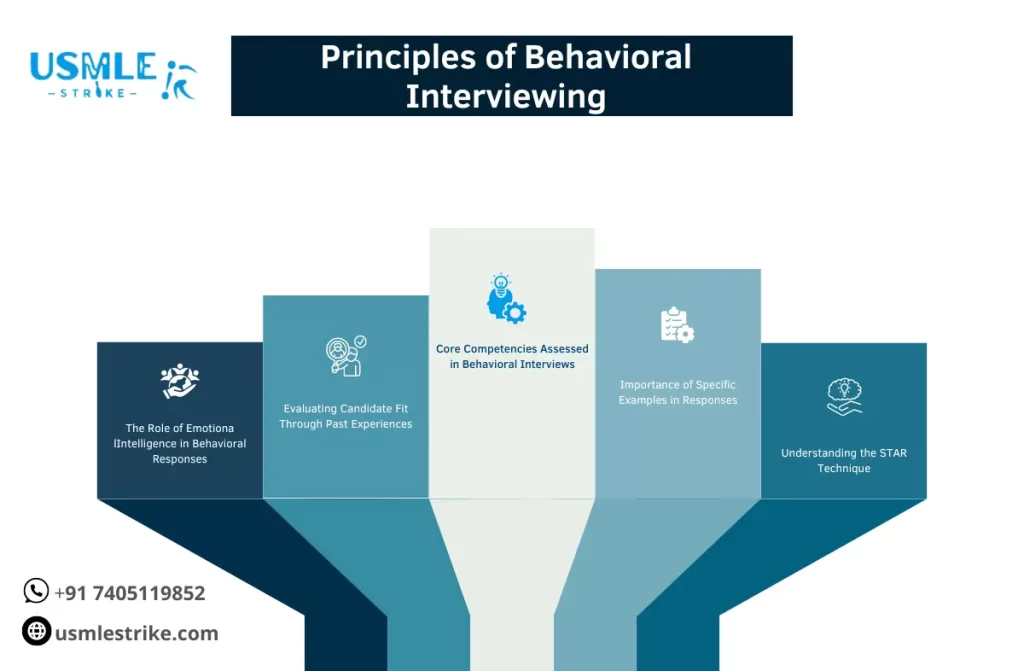
The STAR method is the simplest way to keep a behavioral answer on track. It stands for Situation, Task, Action, and Result.
Situation sets the scene. Keep this short, just enough for the interviewer to picture where you were.
Task explains what you were responsible for in that moment.
Action is the part to spend the most time on. What did you actually do, step by step.
Result covers what happened, and just as importantly, what you took away from it. A story that ends with the outcome but skips the lesson feels unfinished to an interviewer.
Say you get asked about a time you dealt with a difficult patient. Using STAR, you would set up the situation in a sentence or two, explain what you needed to accomplish, walk through the specific things you said and did, and close with how it turned out and what you would do the same or differently next time.
Common Question Types
Most behavioral questions fall into a handful of categories, and it helps to have at least one solid story ready for each.
Teamwork questions ask about working with a difficult colleague or stepping into a leadership role. Interviewers want to hear how you handled the friction, not just that you were friendly about it.
Problem solving questions ask about a tough call you had to make under pressure, or a hard case you managed. Focus on how you thought through the problem, not just the outcome.
Communication questions ask about explaining something difficult to a patient, or resolving a miscommunication with a colleague. Show how you adjusted your approach to the person in front of you.
Ethics and professionalism questions ask about a moment your integrity was tested. These answers should show that you took the harder, more honest path, even when it was not the easy one.
Getting Ready
Start by going back through your clinical rotations and pulling out three or four real moments, not vague summaries. A specific patient, a specific shift, a specific disagreement. Vague stories are the number one reason behavioral answers fall flat, so specificity matters more than polish here.
Look at what each program says it values before your interview. A program that talks a lot about mentorship and teaching wants different stories than one that emphasizes independence and research. You do not need a different personality for each interview, just a sense of which of your real stories fits best.
Practice saying your answers out loud, not just thinking through them. Stories that sound clear in your head often come out tangled the first time you say them, so run through them a few times before interview day.
Mistakes That Sink Good Answers
Being too vague. General statements like “I’m a good communicator” do not stick. A specific story does.
Talking too long. A rambling five minute answer loses the interviewer halfway through. Aim for something closer to a minute or two, and let the STAR structure keep you on track.
Speaking badly about someone. Even if a colleague genuinely made things harder, framing them as the villain of the story reflects worse on you than on them.
Skipping the reflection. Ending with what happened, without saying what you learned, leaves the interviewer without the part they actually wanted.
Drifting off topic. If the question was about conflict, answer about conflict. Do not answer the question you wish they had asked instead.
Sample Questions to Prepare For
Here are some real behavioral questions you are likely to hear in some form.
Describe a time you faced a serious challenge in a clinical setting and how you handled it.
Tell me about a time you worked closely with a team and what you contributed.
Describe a time you had to deliver bad news to a patient or family.
Tell me about a time you had to adapt quickly to a sudden change during a rotation.
Describe a conflict you had with a colleague and how you worked through it.
Tell me about a time you received hard feedback and what you did with it.
Describe a moment you were not happy with your own work and what you did about it.
Should You Ask Questions at the End?
Yes. This part of the interview is not just a formality, it is your chance to show real interest in the program rather than just answering well. Skipping it, or asking something you could have found on the website in thirty seconds, makes it look like you did not prepare.
Good questions to ask are about things that are hard to find online. How the program supports resident wellbeing, what research opportunities actually look like day to day, or something specific that came up earlier in your interview. A thoughtful question at the end often sticks with an interviewer longer than a polished answer earlier in the conversation.
Final Thoughts
Behavioral questions are not a trick. They are just asking you to tell the truth about a real moment, clearly and with a point. Pick a handful of real stories, structure them with STAR, practice saying them out loud, and you will walk into your interview with something better than a script. You will have real answers.