

If you have started looking into Step 1 prep, you already know the problem. There is too much advice and most of it contradicts itself. One source tells you to start with First Aid. Another tells you to start with UWorld. Someone else swears by a 10 week plan while your friend just barely scraped through in 4 weeks.
This guide cuts through that. We will walk through how to build a USMLE Step 1 study schedule that fits your actual timeline, whether you have one month, three months, or six months left. We will also cover what the exam looks like right now, since the format is changing in 2026 according to current USMLE announcements, and a few things tutors rarely say out loud.
A quick note on timing before we go further. According to the United States Medical Licensing Examination program, exams taken before May 14, 2026 use seven 60 minute blocks with up to 40 questions each. Exams taken on or after that date move to fourteen 30 minute blocks with up to 20 questions each. Either way, the total stays at up to 280 questions across a single 8 hour session. The science tested has not changed. Only the pacing has. Always confirm the exact details on the official USMLE site before you build your final study timeline, since exam logistics can shift.
Why Most Step 1 Study Schedules Fail
Most students do not fail Step 1 because they did not study enough. They fail because their study plan was built around someone else’s brain, not their own.
A good Step 1 preparation strategy starts with knowing where you actually stand. Take one early diagnostic, an NBME self assessment works well for this, before you build out your full calendar. NBME self assessments, published by the National Board of Medical Examiners, provide a performance estimate that helps gauge your readiness for Step 1. This gives you a real starting point instead of a guess.
Once you know your weak subjects, your study timeline should reflect that. Spend more days on what you struggle with. Spend fewer on what you already know well. This sounds obvious, but most generic study calendars you find online split time evenly across every subject regardless of your actual starting point.
Building Your Own Step 1 Study Schedule
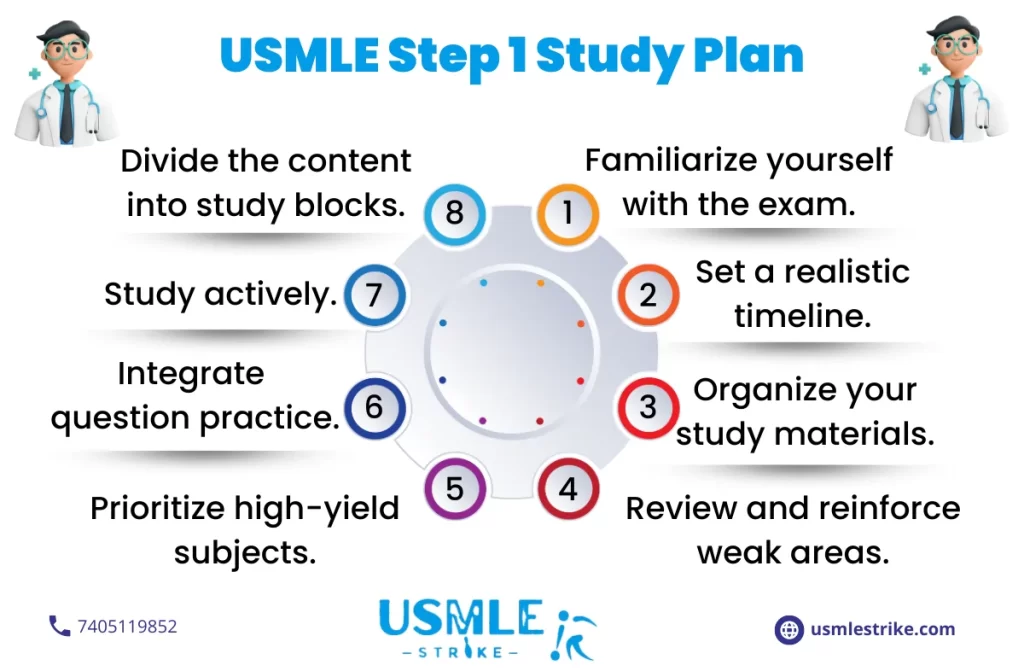
Here is the basic structure every solid prep plan needs, no matter how many weeks or months you have.
Start by getting familiar with the current content outline so you know what is actually tested. Pull the most recent version directly from the official USMLE site rather than relying on an old PDF someone shared in a group chat.
Next, run a diagnostic test in your first week. This single step changes everything else about your plan, since it tells you exactly where your time should go.
After that, set small weekly goals instead of one giant goal for the whole prep period. A goal like finish cardiology and renal this week is far easier to track than a vague goal like study harder.
Break your study days into blocks with real breaks built in. Two hour sessions with a short break in between work well for most people. Marathon six hour sessions without breaks usually backfire by week two.
Save your weekends, or at least one day a week, purely for review. New material every single day for months without circling back is one of the fastest ways to forget what you learned in week one.
What to Actually Use to Study
You do not need fifteen resources. You need three or four that work well together and the discipline to stick with them.
First Aid for the USMLE Step 1 works as your core spine. It will not teach you everything from scratch, but it is the best single place to consolidate what you learn elsewhere.
UWorld is widely considered the leading question bank by many successful Step 1 candidates. Use it as a learning tool first, not a test. Read every explanation, right or wrong, since the explanations teach you more than the questions themselves.
Pathoma is excellent for pathology specifically, and pathology carries a heavy share of Step 1 questions, so this one is worth the time investment.
Sketchy Medical works well for microbiology and pharmacology if you learn better through visual memory tricks than plain text.
Anki, used with a premade deck rather than building your own from scratch, helps lock in facts through spaced repetition over weeks instead of cramming them the night before.
Pick your combination early and stay with it. Switching resources constantly in the middle of your prep wastes more time than it saves.
A Sample Weekly Rhythm
Here is roughly how a single study day can flow once you are a few weeks into your Step 1 revision plan.
In the morning, work through a block of UWorld questions, somewhere around 40, and give yourself a full hour to review every explanation afterward, not just the ones you got wrong.
In the afternoon, study new content tied to whatever weak subject you flagged earlier. Videos, text, or extra question sets all work here.
Later in the afternoon, go back to a topic that has been giving you trouble for more than a few days. Repetition on stubborn topics matters more than piling on brand new content.
In the evening, spend at least an hour on flashcard review. This is the part students skip most often when tired, and it is usually the part that pays off most by exam week.
As your exam date gets closer, shift more of your UWorld practice into timed mode instead of tutor mode. Early on, tutor mode helps you learn. Closer to test day, timed mode trains your pacing and stamina, which matters even more if your exam falls under the newer format with its shorter 30 minute blocks.
1 Month Step 1 Study Plan
If you are short on time, this plan demands real focus every single day.
| Days | Focus | Core Resources | Daily Practice |
|---|---|---|---|
| 1 to 5 | Biochemistry and Genetics | First Aid, Pathoma, Anki | UWorld, 50 questions |
| 6 to 10 | Microbiology and Immunology | SketchyMicro, First Aid, Anki | UWorld, 50 questions |
| 11 to 15 | Pharmacology | First Aid, Anki | UWorld, 50 questions |
| 16 to 20 | Physiology | First Aid | UWorld, 50 questions |
| 21 to 25 | Pathology and Anatomy | Pathoma, First Aid | UWorld, 50 questions |
| 26 to 30 | Full review and practice exams | First Aid, NBME forms | UWorld, 80 questions |
3 Month Step 1 Study Plan
This gives you more breathing room to actually understand material instead of just memorizing it.
| Weeks | Focus | Core Resources | Daily Practice |
|---|---|---|---|
| 1 to 2 | Biochemistry and Molecular Biology | First Aid, Anki | UWorld, 30 questions |
| 3 to 4 | Microbiology and Immunology | SketchyMicro, First Aid | UWorld, 30 questions |
| 5 to 6 | Pharmacology and Physiology | First Aid | UWorld, 40 questions |
| 7 to 8 | Pathology | Pathoma, First Aid, Anki | UWorld, 40 questions |
| 9 to 10 | Anatomy, Embryology, and Behavioral Science | First Aid | UWorld, 50 questions |
| 11 to 12 | Full review and mock exams | First Aid, UWorld, NBME forms | UWorld, 60 questions |
6 Month Step 1 Study Plan
This is the most forgiving timeline and works well if you are starting early in medical school.
| Month | Focus | Core Resources | Daily Practice |
|---|---|---|---|
| 1 | Biochemistry and Genetics | Anki, First Aid | UWorld, 20 questions |
| 2 | Microbiology and Immunology | SketchyMicro, First Aid, Anki | UWorld, 20 questions |
| 3 | Pharmacology and Pathology | Pathoma, First Aid | UWorld, 30 questions |
| 4 | Physiology, Anatomy, and Embryology | First Aid | UWorld, 30 questions |
| 5 | Behavioral Science and Biostatistics | First Aid, Anki | UWorld, 40 questions |
| 6 | Full review and practice exams | First Aid, NBME forms, UWorld | UWorld, 50 questions |
The 75 25 Rule for Your Prep
Split your entire prep period into two phases instead of treating it as one long blur of studying.
Spend roughly 75 percent of your time in the preparatory phase. The goal here is simple. Learn the material well enough that you understand why an answer is right, not just that it is right. Go through First Aid once fully during this stretch and start UWorld from day one rather than saving it for later. Keep a running notebook, some students call this a UWorld journal, where you jot down anything from a question explanation that taught you something new.
Spend the remaining 25 percent in the revision phase. This is where you go back through UWorld a second time, aiming for 80 to 100 questions a day, and start practicing full timed blocks to build stamina. Take an NBME assessment at the start of this phase to see exactly where you stand, then take another one every week or so to track real progress instead of guessing. Toward the very end, run two back to back four hour timed blocks in one sitting at least once. This is the closest thing to a dry run for the actual 8 hour exam day.
Avoiding Burnout During Step 1 Prep
A long Step 1 prep plan can wear you down faster than the material itself. Burnout usually shows up as trouble concentrating, irritability, or feeling like nothing you study is sticking anymore, even on topics you understood fine last week.
Protect at least one half day a week with no new content. Use it to rest, see friends, or just do something that has nothing to do with medicine.
Keep your sleep consistent. Pulling late nights to cram more content in usually backfires the next day through slower recall and more careless mistakes on practice questions.
Move your body, even briefly. A short walk between study blocks does more for focus than another cup of coffee.
Watch for warning signs early. If your practice scores drop for two assessments in a row and you feel constantly exhausted, that is usually burnout creeping in, not a sign you need to study harder. Often the better move is a short planned break, not more hours at the desk.
What to Do in Your Last Week Before Step 1
The final week is not the time to start anything new. It is purely about consolidation and protecting your energy.
Spend most of your time reviewing your existing notes, your First Aid annotations, and your UWorld journal rather than touching new content. At this point, new material adds more stress than value.
Do a lighter pass through your weakest two or three subjects rather than trying to re-cover everything.
Take one final timed practice block two or three days out, not the night before, so you finish on a confident note rather than a stressful one.
Sort out your logistics early. Confirm your test center, your ID, your confirmation number, and your route there, so none of that becomes a last minute scramble.
In the final 24 to 48 hours, ease off practice questions almost entirely. Light review, good sleep, and a calm mind do more for your score at this point than another 100 questions.
Final Thoughts
A good USMLE Step 1 study schedule is not about copying someone else’s calendar word for word. It is about knowing your weak subjects, picking a small set of resources you trust, and giving yourself enough structured time to actually absorb the material instead of just skimming it.
Whether you have one month or six, the plan only works if you follow it consistently and adjust it honestly based on your practice scores. Build your prep plan around the exam format confirmed for your test date, study the subjects that carry the most weight, and protect a little time each week just for review and rest. That combination, more than any single resource, is what gets students across the finish line on exam day.
Read also: USMLE Step 1 Course Mastery