


Picking the best USMLE courses is a real decision with real cost and time attached, so it deserves more than a features list. This guide walks through what each Step actually tests, what separates a genuinely useful course from a bundle of recycled video lectures, and where USMLE Strike’s courses fit into that picture.
What Each USMLE Step Actually Tests
- Step 1 focuses on basic sciences, anatomy, biochemistry, physiology, pharmacology, pathology, and microbiology, tested through clinical vignettes rather than isolated recall. For the current exam format and passing standard, see our USMLE Step 1 Study Guide.
- Step 2 CK tests clinical knowledge and diagnostic reasoning, essentially whether you can decide what to do next for a patient in front of you. The Clinical Skills (CS) component that used to run alongside CK was permanently discontinued in 2021, so Step 2 today is CK only. See our Step 2 Exam Study Schedule for a detailed prep plan.
- Step 3 tests independent patient management through multiple-choice items and computer-based case simulations, and is only administered in the United States.
Registration, eligibility windows, and testing centers work differently from a typical university exam. If you haven’t gone through that process yet, our guide to USMLE Exam Dates and Scheduling covers how the FSMB registration system and Prometric booking actually work, and our USMLE Exam Fees breakdown covers current costs for Indian candidates.
What to Look for in a Prep Course
Rather than taking any provider’s word for it, evaluate a course against criteria you can actually verify:
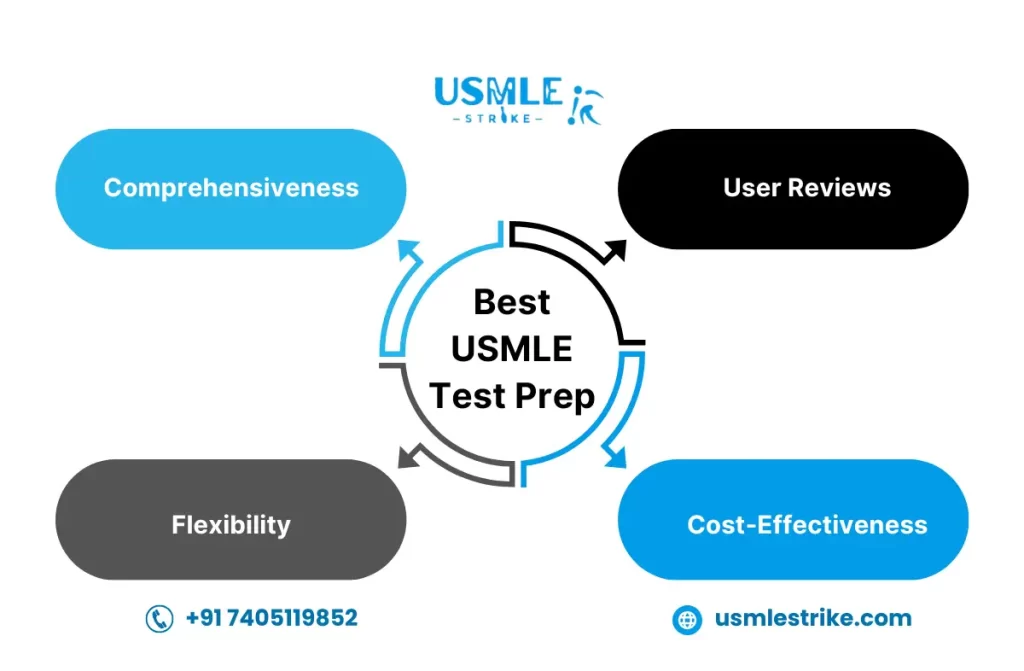
- Content coverage: Does the course map to the current content outline for the Step you’re taking, updated for the 2026 block-format changes?
- Qbank quality: Are explanations detailed enough to teach the underlying concept, not just confirm the right answer? Can you filter and repeat questions by system or weak area?
- Access to faculty: Can you actually get a question answered by someone qualified, and how quickly?
- Format fit: Does the course match how you learn, video-first, reading-first, or question-first, and can you try it before committing?
- Cost transparency: Is pricing clear upfront, with no hidden fees for question banks, mock exams, or faculty access?
These criteria apply whether you’re evaluating USMLE Strike, UWorld, Kaplan, Lecturio, or anything else. We’d rather you use them to make an informed choice than take a features table at face value, especially since third-party providers update their offerings frequently enough that a static comparison table goes stale fast. If you want to compare providers directly, check each platform’s own site for current pricing and included features rather than relying on a secondhand summary.
Core Components: Video Lectures, Qbanks, and Live Support
Most solid prep plans combine three things, and how a course delivers each one is what actually differentiates it:
- Video lectures build foundational understanding before you start heavy practice. Look for lectures organized by system, not just by textbook chapter, so they map cleanly onto how questions are actually asked.
- A question bank (Qbank) is where most of your score improvement comes from. The strongest ones simulate the current exam interface (20-question, 30-minute blocks under the 2026 format) and give you a written explanation for every answer choice, not just the correct one.
- Live or direct faculty access matters most when you hit a concept that video lectures and written explanations don’t resolve on their own. This is the component most often missing or limited in self-paced-only platforms.
How USMLE Strike’s Courses are Structured
USMLE Strike offers three separate courses, one per Step, rather than a single bundled package:
- Step 1 Course: Video lectures and a Qbank organized around high-yield basic science topics, with faculty-led doubt resolution for concepts that don’t click from video alone.
- Step 2 CK Course: Case-based learning built around clinical decision-making scenarios, paired with practice questions in the current block format.
- Step 3 Course: Focused on patient management and clinical judgment, the areas Step 3 tests most heavily.
Courses are built specifically with Indian medical students and IMGs in mind, taught by Dr. Apurva Popat, a Cardiovascular Disease Fellow and former Chief Resident at Marshfield Clinic who has coached USMLE candidates since 2013.
We don’t currently publish match-rate or average score-improvement statistics for USMLE Strike students on this page. If you’d like specific outcome data, ask us directly, we can walk you through real examples from past students.
Questions to Ask Before Choosing a Course
Whichever provider you’re considering, USMLE Strike included, these are worth asking directly rather than assuming from marketing copy:
- What’s included in the base price, and what costs extra?
- How many practice questions are in the Qbank, and how often are they updated for content and format changes?
- Is there a trial period or sample content before you commit?
- How is faculty access structured, scheduled sessions, on-demand messaging, or both?
- Can you speak to a past student about their actual experience with the course?
Related USMLE Strike Guides
- USMLE Step 1 Study Guide
- Step 2 Exam Study Schedule
- USMLE Exam Fees: A Complete Financial Breakdown for Indian Aspirants
- USMLE Exam Dates and Scheduling
- Best USMLE Practice Questions to Boost Your Prep
Conclusion
The right prep course is the one that matches how you actually study, covers the current exam content and format, and gives you real access to explanations when you’re stuck, not the one with the longest features list. Use the criteria above to evaluate any course you’re considering, including ours. If you want to see USMLE Strike’s Step 1, Step 2 CK, or Step 3 course content directly, reach out and we’ll walk you through it.