

Every year, thousands of medical graduates wait for one single day that decides where they will spend the next three to seven years of their life. That day is Match Day. And the system behind it is called the Residency Match Program.
If you are preparing for this process, you already know it is not simple. There are exams, applications, interviews, and a matching algorithm that places everyone at once based on shared preferences. This guide walks through exactly how the Residency Match Program works, what it costs, what the timeline looks like, and what actually helps IMGs match successfully.
What is the Residency Match Program?
The Residency Match Program is the system that places medical graduates into residency training spots across the United States. It is run by the National Resident Matching Program, usually just called the Match or NRMP.
Here is how it works in plain terms. You make a list of programs you want, ranked in order. Each program makes a list of applicants they want, ranked in order. A computer compares both rank lists and places applicants into the most favorable available match based on those shared preferences. No human decides the final outcome. The algorithm does.
This system exists because hiring residents one by one, the old way, created chaos. Programs would pressure students to commit early, students would lose better offers, and nobody had real certainty until the last minute. The Residency Match Program fixes that by making everyone commit to their true preferences at the same time.
Why this Process Matters So Much
You cannot practice medicine in the United States without completing a residency. So this one process is the gate you have to pass through, no matter how strong your MBBS degree or your Step scores are.
For IMGs especially, the Match is the real test. Your exams get you eligible. Your application and interviews get you noticed. But the Residency Match Program is what actually places you somewhere. Many doctors with excellent scores still go unmatched because they misunderstood how the system works or applied too narrowly.
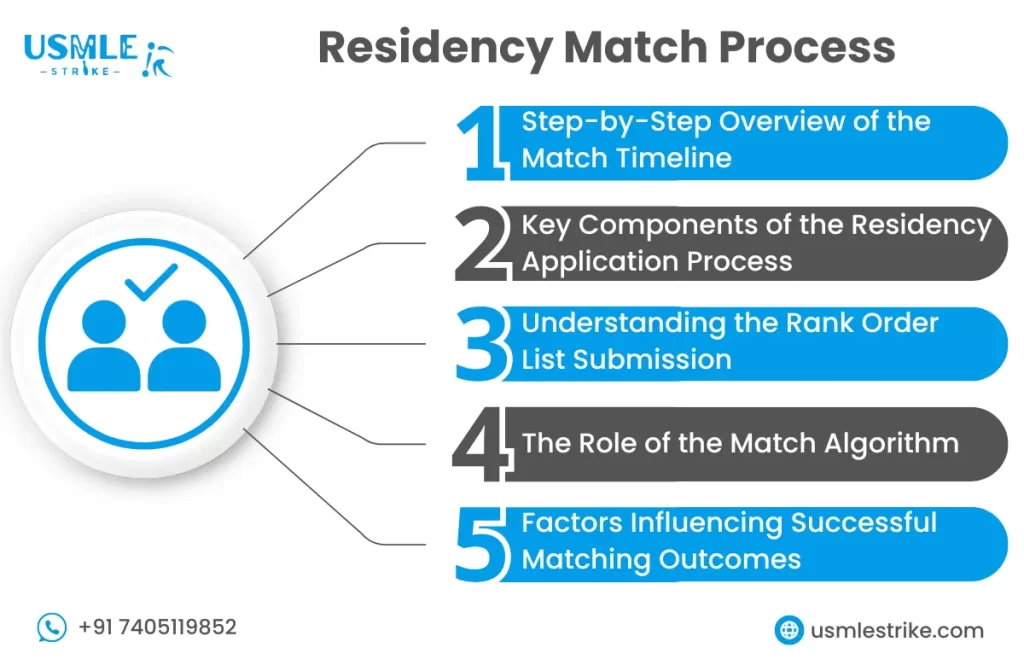
How the Residency Match Program Works Step by Step
Step 1: Get Eligible First
Before you can even think about applying, you need a few things in place.
You need your MBBS or equivalent degree completed. You need to pass USMLE Step 1 and Step 2 CK. And you need ECFMG certification, which confirms your medical education meets US standards.
Step 2: Apply Through ERAS
Once eligible, you apply through ERAS, the application system every program uses. This is where you submit your CV, personal statement, USMLE scores, transcripts, and letters of recommendation. Research and papers now go under the Scholarly Work section, which is the AAMC’s renamed and redesigned version of the older Publications section. Keep entries in plain text format here so nothing looks garbled once programs view your final application.
Most IMGs apply to many programs at once through this single system, which is also where most of your early cost goes.
Step 3: Get Through Interviews
If a program likes your application, they invite you to interview. This is not just a formality. Interview performance often decides your final ranking more than your paper scores do.
Program signaling has also changed how interview invitations work in recent cycles. Applicants can send a limited number of signals to show genuine interest in specific programs. Using your signals on programs you are realistically competitive for can meaningfully improve your interview odds.
Step 4: Submit Your Rank Order List
After interviews, you make your final list. You rank every program you interviewed with, from your top choice to your last.
Here is the part people get wrong. You should rank based on what you actually want, not what you think you have a chance at. The system is built so that honest ranking gives you the best possible outcome. Trying to be strategic by ranking a safer program higher than your real first choice usually backfires.
Step 5: The Matching Algorithm Does Its Work
The Residency Match Program uses what is called an applicant proposing algorithm. Without going into the math, the short version is this. It tries to give you your highest ranked program first. If that program does not also want you enough, it moves to your next choice. It keeps going until every applicant and every program is matched as well as possible given everyone’s preferences.
Step 6: Match Day
The process culminates on Match Day. Results go live. You find out where you are headed for the next several years of your life.
What Does the Match Actually Cost?
This part rarely gets talked about, but it matters a lot when you are budgeting your USMLE journey. Approximate costs vary by application cycle, so always check current NRMP and ERAS fee schedules before you apply.
| Expense | Approximate Cost |
|---|---|
| ERAS application fees (scales with number of programs) | $1,500 to $4,000 |
| Interview travel and lodging | $2,000 to $6,000 |
| NRMP registration fee | $100 to $150 |
| Visa and documentation costs | $500 to $1,500 |
| Total estimated cost | $4,000 to $12,000+ |
ERAS fees increase the more programs you apply to. The first 10 programs cost less per application, then the price climbs steadily after that. Since IMGs often need to apply to 100 or more programs to get enough interviews, this adds up fast. Budget for this early so it does not catch you off guard mid cycle.
Match Statistics You Should Actually Know
Numbers help you set realistic expectations. Here is what the data shows, based on figures published by the National Resident Matching Program and the Association of American Medical Colleges.
Around 90 percent of US MD graduates match successfully each year, according to NRMP outcome data. For IMGs, the number is lower, typically between 55 and 65 percent depending on specialty and how strong the application is.
Step 2 CK score remains the single biggest screening factor for IMGs in the Residency Match Program. Most programs use a cutoff somewhere between 220 and 240. Competitive specialties often expect scores above 250.
Interview count matters more than people think, though the exact number needed has shifted slightly with the introduction of program signaling and the wider use of virtual interviews. Historically, 12 or more interviews pushed match odds above 85 percent. Under the current signaling system, some specialties need fewer. Internal Medicine applicants with 8 to 10 strong, well targeted interviews now see high match rates as well. Fewer than 5 interviews still puts you at real risk regardless of specialty.
This is exactly why IMGs are told to apply broadly, often to 100 to 150 programs. It feels excessive, but the math supports it.
Specialty also changes your odds heavily within the Residency Match Program. Internal Medicine, Family Medicine, and Pediatrics are far friendlier to IMGs. Dermatology, Orthopedics, and Plastic Surgery are extremely hard to match into as an IMG, even with strong scores.
The Critical Path to Match Day
The sequential milestones of the Residency Match Program cannot be skipped or taken out of order. Below is a typical Residency Match Timeline based on the current NRMP and AAMC application cycle. Always confirm exact dates on the official NRMP site, since deadlines can shift slightly each year.
| Milestone | Typical Timing | What Happens |
|---|---|---|
| ECFMG certification and strategy | January to May | Begin ECFMG certification, verify credentials, and secure US clinical experience early to lock in strong letters of recommendation |
| ERAS portal opens | Early June | The MyERAS token becomes available so you can start entering your history, experiences, and Scholarly Work entries |
| Application submission | Early September | The window opens to officially submit your finalized ERAS application, personal statement, and letters to programs |
| Program review access | Late September | Program directors begin reviewing applications, and interview invitations start rolling out shortly after |
| Standard registration deadline | Late January | Final day to register for the Match and SOAP without a late fee |
| Rank Order List deadline | Early March | Hard deadline to submit and certify your Rank Order List, with no extensions granted |
| Match Week and SOAP | Mid March | Match Week begins, and unmatched applicants enter SOAP rounds immediately |
| Match Day | Mid to late March | Final placement results are released, revealing exactly where you will train |
This structured Residency Match Timeline gives you a realistic frame for planning, even though the exact calendar dates shift slightly from one cycle to the next.
What Happens During Match Week
Match Week is not just one moment. It unfolds over several days.
First, you get a simple yes or no. You find out if you matched, but not where yet. This alone causes a lot of anxiety because you have to sit with the answer for a day or two before learning the actual program.
If you matched, the full results come out later in the week and you learn your program.
If you did not match, you move into SOAP, the Supplemental Offer and Acceptance Program. This is a fast and intense few days where unfilled positions get offered to unmatched applicants. Programs and applicants move quickly, often within hours, so you need to be ready to respond immediately if you end up here.
Match Versus SOAP
It helps to see these side by side since people often confuse them.
| Factor | The Match | SOAP |
|---|---|---|
| When it happens | Result released on Match Day | Happens during Match Week if unmatched |
| Speed | Decided weeks in advance through ranking | Decided within hours or days |
| Your control | High, based on your rank list | Lower, based on what is still open |
| Outcome certainty | Known once results release | Uncertain until offers are accepted |
If you go unmatched, SOAP is not a failure path. Many strong doctors end up there simply because of numbers, not because they were unqualified. Acting fast and staying flexible on specialty or location during SOAP improves your odds significantly.
Mapping Residency Program Types
Not all residency programs in the Residency Match Program work the same way. Understanding how these tracks function side by side prevents costly application errors.
| Program Type | Duration | Training Scope | Match Strategy |
|---|---|---|---|
| Categorical | Full length, 3 to 7 years | Complete training in one specialty from day one to board eligibility | Simple, rank the program directly on your ROL |
| Preliminary | 1 year only | Foundational clinical training, usually Internal Medicine or General Surgery | Required as a prerequisite before starting an Advanced program |
| Advanced | Year 2 to finish | Specialized training starting at PGY-2, such as Radiology or Neurology | Must pair this with a complementary Preliminary year on a supplemental rank list |
| Transitional | 1 year only | A broad, rotating internship across multiple medical and surgical disciplines | Offers a flexible first year before moving into an Advanced track |
How to Actually Improve Your Match Chances
A few things consistently separate doctors who match from those who do not.
Your Step 2 CK score matters most. This is the first filter most programs apply before reading anything else in your file. A higher score simply gets you seen by more programs.
Apply broadly and realistically. This means applying to enough programs across a few specialties, including some backup options, instead of only chasing your dream specialty.
US clinical experience helps your credibility a lot. Time spent working alongside US physicians, even as an observer, gives you stronger letters of recommendation and shows program directors you can function in their system.
Use your program signals wisely. Since signaling now plays a role in how programs prioritize interview invites, send yours to programs where your profile genuinely fits rather than spreading them too thin.
Your personal statement should sound like you, not like a template. Program directors read hundreds of these. The ones that mention a real moment or a real reason for choosing the specialty stand out far more than generic statements about passion for medicine.
Interview prep matters more than people expect. Two applicants with identical scores can have very different outcomes based on how they come across in a 20 minute conversation.
Rank your list honestly. Do not rank a program higher just because you think you have a better shot there. The algorithm rewards honesty, not strategy.
Common Mistakes that Cost People a Match
A few patterns show up again and again among doctors who go unmatched in the Residency Match Program.
Applying too narrowly is the most common one. Some applicants apply to only 20 or 30 programs in a highly competitive specialty and end up with very few interviews.
Weak personal statements that read like a list of achievements instead of an actual story also hurt more than people realize.
Skipping US clinical experience is another common gap, especially for applicants who assume strong exam scores alone will carry them through.
Missing deadlines is the most avoidable mistake on this list. The Match does not give extensions. Mark every date the moment you know it.
A Quick Way to Think About Specialty Choice
If you are still deciding on a specialty, ask yourself a few honest questions.
Do you prefer hands on procedural work, or do you enjoy long term diagnosis and management more. This alone usually points you toward surgical versus medical specialties.
Can you handle frequent overnight calls, or do you need a more predictable schedule. Surgery and emergency medicine demand a lot here. Radiology and Dermatology demand much less.
Are you open to relocating to almost any state for training. Being flexible on location opens up far more programs and interview opportunities.
Does your Step 2 CK score realistically support a competitive specialty. A score below 230 makes fields like Dermatology and Orthopedics very difficult, though not impossible with an otherwise outstanding file.
Answering these honestly before you apply saves you time, money, and a lot of stress later.
Final Thoughts
The Residency Match Program can feel overwhelming when you are in the middle of it. Exams, applications, interviews, and then one single day that decides everything. But once you understand how each piece fits together, it becomes a process you can actually plan for instead of just hope through.
Focus on your Step 2 CK score, apply broadly and honestly, get real clinical experience where you can, and respect every deadline on the timeline. Doctors who do these consistently well are the ones who succeed in the Residency Match Program, year after year.