

If you are an international medical graduate, you already know that not every residency program gives you a fair shot. Some programs barely look at IMG applications. Others actively want you on their team. The second kind are what people call IMG friendly residency programs, and finding them is honestly one of the biggest levers you can pull in your match strategy.
This guide walks through what makes a program IMG friendly, which specialties and states give you the best odds, and how to actually use this information when building your application list. We are using NRMP Charting Outcomes trends and ACGME workforce data throughout, so the numbers here reflect general patterns rather than guesses. Always confirm exact figures on nrmp.org since they shift slightly every cycle.
What is an International Medical Graduate?
An international medical graduate, or IMG, is simply a doctor who finished medical school outside the United States or Canada. This includes graduates from India, Pakistan, the Caribbean, the Philippines, and many other countries who want to train and practice medicine in the US.
Before you can apply to IMG friendly residency programs, a few things need to be in place.
You need ECFMG certification. This confirms your medical degree meets US standards, and without it, you cannot submit an ERAS application at all.
Most IMGs need to pass USMLE Step 1 and Step 2 CK before applying to residency. Step 3 is not required by most residency programs at the application stage, though it can help certain visa dependent applicants and is required later for full licensure. Step 2 CK carries the most weight for screening, since it reflects clinical knowledge most directly.
You also need some form of US clinical experience. Observerships, externships, or clinical rotations at US hospitals all count toward this. Programs use it to judge whether you can function inside the US healthcare system from day one.
What actually Makes a Program IMG Friendly
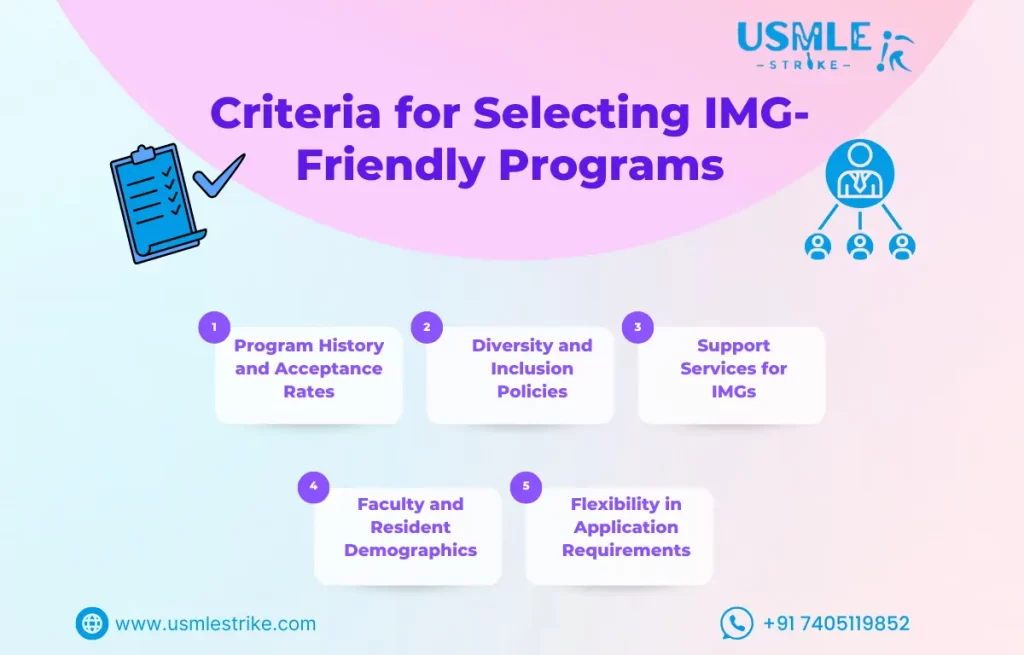
Not every program treats international applicants the same way. A genuinely IMG friendly residency program usually shows a few clear signs.
The clearest sign is a high historical IMG percentage among current residents. Programs where a large share of residents are IMGs tend to have a real track record, not just a stated policy. You can check this yourself on FREIDA, which is the AMA’s free online directory of accredited residency programs, at freida.ama-assn.org. Doximity Residency Navigator is another option for the same kind of lookup.
The second sign is flexible scoring. IMG friendly programs tend to review applications as a whole picture instead of relying only on a hard Step score cutoff. Your clinical experience, your letters, and your overall story carry real weight alongside your scores.
The third sign is visa sponsorship. A program that sponsors J-1 or H-1B visas is genuinely reachable for non-US citizens. A program with no sponsorship history effectively closes its doors to most IMGs no matter how strong their application is.
The fourth sign is a relaxed year of graduation policy. Some programs automatically reject anyone who graduated more than five years ago. Programs that are more open to IMGs either skip this rule entirely or apply it loosely, especially when clinical experience is strong.
The fifth sign is mentorship. Programs with structured support from faculty, senior residents, and an established IMG alumni network make the adjustment into US training noticeably smoother.
IMG Match Rates by Specialty
Knowing which specialties are realistically open to you saves time and application fees. The table below reflects general accessibility patterns based on NRMP Charting Outcomes trends. These are directional estimates rather than exact published percentages, so check current data at nrmp.org before finalizing your list.
| Specialty | IMG Accessibility | Quick Note |
|---|---|---|
| Internal Medicine | High | Largest IMG pipeline, most accessible specialty overall |
| Family Medicine | High | Strong history with IMGs, especially community programs |
| Psychiatry | Moderate to High | Growing fast due to nationwide shortage |
| Pediatrics | Moderate to High | Steady acceptance across academic and community sites |
| Pathology | Moderate | Less competitive, good fit with a research background |
| Neurology | Moderate | Easier at community programs, harder at academic centers |
| Physical Medicine and Rehab | Moderate | Underserved by US grads, growing IMG acceptance |
| General Surgery | Lower | Mostly accessible at specific community programs |
| Radiology | Lower | Highly competitive with very few IMG friendly slots |
| Dermatology | Very Low | Extremely competitive, rarely open to IMGs |
| Orthopedic Surgery | Very Low | One of the hardest specialties for IMGs to enter |
| Plastic Surgery | Very Low | Very limited IMG match history nationally |
Internal Medicine, Family Medicine, Psychiatry, and Pediatrics remain the most realistic paths into IMG friendly residency programs. Dermatology, Orthopedics, and Plastic Surgery stay difficult even for IMGs with strong scores.
Best States for IMG Friendly Residency Programs
Location matters more than most applicants realize. Some states have a much larger network of community hospitals that consistently train IMGs.
| State | IMG Participation | Strongest Specialties |
|---|---|---|
| New York | Very High | Internal Medicine, Family Medicine |
| New Jersey | Very High | Internal Medicine, Psychiatry |
| Florida | High | Internal Medicine, Pediatrics |
| Michigan | High | Internal Medicine, Pediatrics |
| Pennsylvania | High | Internal Medicine, Neurology |
| Texas | High | Internal Medicine, Family Medicine |
| Illinois | Moderate to High | Internal Medicine, Surgery |
| California | Moderate to High | Internal Medicine, Psychiatry |
New York consistently places more IMGs into residency than any other state, largely due to its large community hospital network. New Jersey is smaller but has one of the highest IMG to resident ratios in the country, which makes it punch above its size for international applicants.
IMG Friendly Residency Hubs by City
A handful of cities have a dense cluster of programs that have historically welcomed IMGs. It is worth being clear here that a city itself is not IMG friendly. The individual programs inside it are. Each city below holds many separate residency programs, and you should verify the specific one you are considering on FREIDA before applying anywhere.
New York City has a long history of Internal Medicine, Surgery, and Pediatrics programs that train large numbers of IMGs through its community hospital network.
Newark and Jersey City carry one of the highest IMG to resident ratios anywhere in the US, with notable placement in Internal Medicine, Psychiatry, and Family Medicine.
Chicago has several programs across Internal Medicine, Psychiatry, and Surgery with a genuinely diverse patient population.
Miami has programs in Family Medicine, Pediatrics, and Internal Medicine, often with a multicultural and bilingual training environment.
Houston has Internal Medicine, Neurology, and Pediatrics programs spread across some of the largest hospital systems in the country.
Philadelphia has academic programs in Internal Medicine, Surgery, and OB-GYN with an established IMG community.
Detroit has Internal Medicine, Radiology, and Surgery programs known for hands-on training and steady IMG enrollment.
Baltimore combines strong academic affiliations with a long IMG history across Internal Medicine, Surgery, and Neurology.
Programs Historically Cited by IMG Applicants
The programs below are historically cited by IMG applicants as accessible and supportive, based on shared application experiences. This is not a current ranking or an official designation, and IMG percentages, visa sponsorship, and year of graduation policies can all shift from one cycle to the next. Confirm every detail directly on freida.ama-assn.org before you apply anywhere.
For Internal Medicine, applicants have historically mentioned BronxCare Health System and Lincoln Medical Center in the Bronx, Brookdale University Hospital in Brooklyn, Jersey Shore University Medical Center in Neptune New Jersey, Presence Saints Mary and Elizabeth Medical Center in Chicago, Detroit Medical Center through Wayne State University, Interfaith Medical Center in Brooklyn, University of North Dakota in Fargo, and MercyOne Des Moines in Iowa.
For Family Medicine, the UAMS Regional Programs in Arkansas, Lehigh Valley Health Network in Pennsylvania, Cone Health in Greensboro North Carolina, and Memorial Hospital of Rhode Island in Pawtucket come up frequently in applicant discussions.
For Psychiatry, Interfaith Medical Center in Brooklyn, Bronx Lebanon Hospital, and Nassau University Medical Center in East Meadow New York are commonly mentioned among IMG friendly residency programs.
Hidden Gem Programs Worth Considering
If your Step scores are average or your graduation year is further back, less competitive states and specialties can meaningfully boost your interview volume. This program is historically discussed among matched IMGs, but you should still verify everything directly before applying.
Charleston Area Medical Center in West Virginia runs a Pediatrics program that applicants have described as welcoming, with lower application volume that can mean a better interview conversion rate.
This may be worth a closer look if your Step 2 CK score sits in a moderate range, or if your graduation year is further back than five years.
What the IMG Match Rate Data Shows
The overall non-US IMG match rate has sat around 59 percent in recent NRMP Main Residency Match results, compared to roughly 93 percent for US MD graduates. That gap is a big part of why choosing the right IMG friendly residency programs matters so much. Exact figures shift slightly each cycle, so check nrmp.org for the most current numbers.
The data breaks down further once Step scores enter the picture. IMGs scoring higher on Step 2 CK tend to match at rates closer to US graduates in Internal Medicine and Family Medicine, particularly when applying broadly. IMGs in a moderate score range still match successfully in IMG friendly specialties, often after applying to a large number of programs. IMGs scoring lower face more difficulty even in accessible specialties, and may benefit from building more US clinical experience and research before applying.
Interview count is one of the strongest predictors of match success. Very few interviews generally means low odds. A moderate number puts you in better territory. A high number of interviews, historically cited around twelve or more, has correlated with match probability above 85 percent regardless of specialty, according to NRMP outcome trends.
US citizen IMGs also tend to match at higher rates than non-US IMGs, mainly because they skip the visa sponsorship hurdle entirely.
How to Build Your Program List Around Your Profile
There is no single best list of IMG friendly residency programs. The right list depends on your own profile.
Start by knowing your Step 2 CK range. A higher score opens up more competitive programs. A moderate score keeps you within standard IMG friendly territory. A lower score means focusing specifically on programs with genuinely flexible thresholds rather than hard cutoffs. Cutoffs vary widely by program even within the same specialty, so treat any specific number as a general guide rather than a fixed rule.
Check your year of graduation next. If it has been several years since you graduated, filter specifically for programs without strict year of graduation rules. Some community programs accept graduates many years out.
Confirm visa sponsorship before spending money applying. Every program’s FREIDA profile will tell you whether they sponsor J-1 or H-1B. Applying to a program with no sponsorship history uses up money and an application slot you could have spent elsewhere.
Look at the historical IMG percentage at each program through FREIDA or Doximity. A higher percentage of IMG residents is generally a reassuring signal.
Finally, apply broadly. Most advisors recommend well over 100 programs for IMGs. Applying too narrowly is one of the most common reasons qualified IMGs struggle to secure enough interviews.
How to Actually Improve Your Odds
A few habits tend to separate IMGs who match from those who do not.
Push your Step 2 CK score as high as you reasonably can. This is usually the first filter a program applies before reading anything else in your file. A stronger score widens your realistic list of programs.
Get US clinical experience early, even if it is just a short observership. A single rotation at a hospital where you genuinely want to match can produce a meaningful letter of recommendation and show you understand how the US system runs. AMOpportunities at amopportunities.org is one common way IMGs arrange this.
Get letters from US based physicians whenever you can. A letter from an American attending often carries more weight, since program directors can compare it directly against other applicants they already know.
Write your personal statement around your real story, not a template. Address your IMG background directly instead of dancing around it. Explain what pushed you toward this path and what you genuinely bring to a US training program.
Build real connections during your rotations. A short note from a faculty member saying they worked with you and recommend you can move your application from unread to interviewed.
Practice specifically for virtual interviews, since most residency interviews have been conducted this way for years now. Run through clinical reasoning scenarios and behavioral questions until your answers feel natural.
Final Thoughts
Finding the right IMG friendly residency programs is less about luck and more about strategy. Programs that have historically trained IMGs tend to leave a visible trail through their resident composition, visa sponsorship history, and year of graduation policies. Once you understand your own Step score range and graduation timeline, building a realistic list becomes far less overwhelming.
Internal Medicine, Family Medicine, Psychiatry, and Pediatrics generally offer the strongest odds. Apply broadly, get real US clinical experience where you can, and always verify program details directly on FREIDA before committing your application fees, since policies shift every cycle.