

Indian medical students are increasingly choosing the USMLE exam in India as a pathway to global medical training. The shift is driven by standardized evaluation, structured residency systems, and higher clinical exposure in the United States.
The USMLE exam in India allows candidates to begin preparation and complete key steps without leaving the country. Early planning during MBBS enables integration of basic sciences with clinical reasoning, which is essential for NBME-style questions.
What is the USMLE Exam?
The United States Medical Licensing Examination (USMLE) is a three-step standardized exam conducted by the NBME (National Board of Medical Examiners) and FSMB (Federation of State Medical Boards) to assess a physician’s ability to apply medical knowledge, clinical reasoning, and patient management skills required for medical practice in the United States.
Can You Take the USMLE Exam in India?
Yes. The USMLE exam in India is conducted through Prometric test centers.
- Step 1 and Step 2 CK → Available in India
- Computer-based testing format
- Standardized global question pool
Step 3 is typically taken in the United States as it assesses readiness for unsupervised clinical practice.
USMLE Exam Structure (Step-by-Step)
The examination is designed to test a continuum of medical education, moving from basic science to independent clinical practice.
Step 1: Foundational Sciences
- Focus: Mechanisms of disease, pharmacology, and organ system pathology.
- Format: One-day, 8-hour session.
- Note: Since 2022, this is a Pass/Fail exam. As of May 14, 2026, the interface has transitioned to a new software featuring 30-minute blocks (20 questions each) to improve examinee pacing.
Step 2 CK: Clinical Knowledge
- Focus: Patient management, health promotion, and disease prevention.
- Format: One-day, 9-hour session.
- High-Yield: With Step 1 being Pass/Fail, the numerical score on Step 2 CK is now the primary metric used by Residency Program Directors for screening.
Step 3: Final Licensing
- Focus: Independent practice and clinical decision-making.
- Format: Two-day exam involving Multiple Choice Questions (MCQs) and Computer-based Case Simulations (CCS).
USMLE Pass Rates for IMGs: What to Expect
Passing on the first attempt matters more than most students realize, since a failed attempt stays on the transcript that residency programs see.
| Exam | US MD First-Attempt Pass Rate | IMG First-Attempt Pass Rate |
|---|---|---|
| Step 1 | ~91% | ~72% |
| Step 2 CK | ~96–98% | ~68% |
Step 2 CK’s passing standard rose from 214 to 218 on July 1, 2025, removing the margin of error for candidates scoring in the low 220s on NBME self-assessments. Repeat attempts pass at significantly lower rates (around 54% for Step 1 repeaters), which is why front-loading preparation time before the first attempt matters more than rushing to a test date.
USMLE Pathway for Indian Students (Step-by-Step Process)
- MBBS Enrollment
- Must be from a medical school listed in WDOMS
- ECFMG Certification
- Mandatory for IMGs
- Requires Step 1 + Step 2 CK + OET
- USMLE Steps
- Sequential completion of Step exams
- OET (Occupational English Test)
- Assesses clinical communication
- US Clinical Experience (USCE)
- Observerships or electives
- Strengthens residency applications
- Residency Match (ERAS + NRMP)
- Application + interviews + ranking
- Medical License
- After Step 3 + residency completion
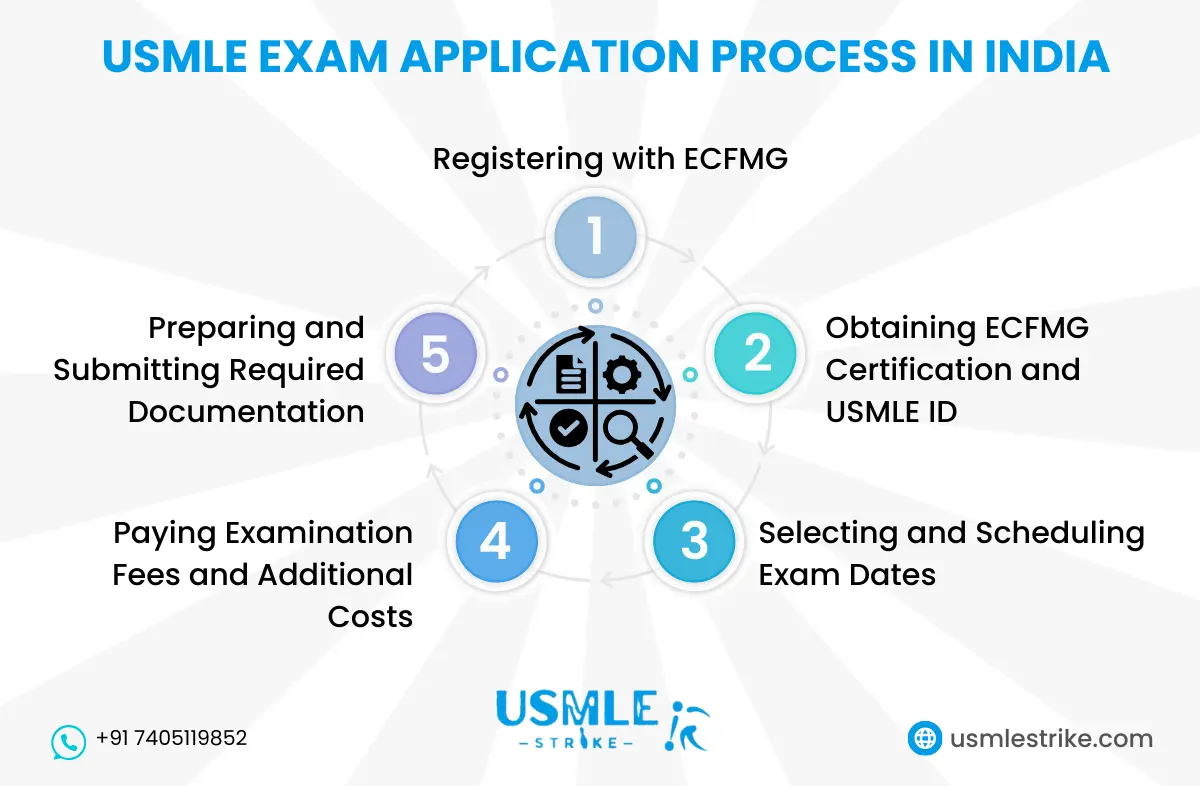
USMLE Exam Centres in India
Prometric centers are the authorized venues for Step 1 and Step 2 CK. To ensure a seat in your preferred window, booking 3–6 months in advance is recommended.
| Region | City |
| North | New Delhi (Gurgaon) |
| South | Chennai, Bangalore, Hyderabad, Thiruvananthapuram |
| West | Mumbai, Ahmedabad |
| East | Kolkata |
👉 Check full list of USMLE centres in India
Why Test in India Instead of Traveling Abroad
Some Indian candidates consider testing in Nepal, UAE, or Singapore, but testing within India is usually the more practical choice.
| Factor | Testing in India | Testing Abroad (Nepal/UAE/Singapore) |
|---|---|---|
| Travel cost | None | Flights, visa, lodging add $500–$1,500+ |
| Familiarity | Home environment, no jet lag | New country, unfamiliar logistics |
| Exam fee | Same base fee + India GST | Same base fee, no GST, but added travel cost |
| Booking flexibility | Multiple cities (Chennai, Mumbai, Delhi, Bangalore, Hyderabad, Kolkata) | Fewer slots, higher competition for seats |
Unless a specific date is unavailable in India, testing locally is almost always the lower-cost, lower-stress option.
How to Book Your USMLE Exam Slot in India
- Register through the FSMB portal at usmle.fsmb.org. Since January 12, 2026, IMGs register for and pay Step exam fees here, not through MyIntealth, which now handles only ECFMG certification itself.
- Select a three-month eligibility period and testing region (India) during registration.
- Receive your scheduling permit once eligibility is confirmed, typically within two weeks.
- Book your Prometric slot at usmle.fsmb.org/schedule, choosing your preferred India city and testing window.
- Confirm your ID details match exactly. The name on your government ID must match your Intealth name of record character for character, or eligibility verification stalls.
Booking 3–6 months in advance is strongly recommended, since seats near residency application deadlines fill quickly.
USMLE Fees in India (2026 Estimates)
The financial commitment for the USMLE pathway includes exam fees, international test delivery surcharges, and applicable local taxes such as GST under OIDAR regulations.
For international medical graduates (IMGs) from India, the USMLE Step 1 fee is approximately $1,050–$1,150 (₹90,000 – ₹1.05 lakh), including the base exam fee, international surcharge, and GST. Similarly, the Step 2 CK fee falls in the range of $1,080–$1,200 (₹92,000 – ₹1.1 lakh) depending on exchange rates and additional charges.
In addition to exam fees, ECFMG certification and pathway costs typically range between $1,500 and $2,000, covering credential verification and required documentation processes.
Overall, when accounting for preparation resources such as a USMLE course, question banks, US clinical experience (USCE), travel, and residency application expenses, the total investment for the USMLE journey from India is approximately ₹20–25 lakhs.
👉 [See complete USMLE fee breakdown in India]
USMLE Preparation in India
Effective USMLE preparation in India is fundamentally concept-driven rather than based on memorization. The exam tests the ability to apply integrated medical knowledge rather than recall isolated facts. This requires a shift from traditional study methods toward mechanism-based understanding. Students must focus on how concepts connect across subjects rather than studying them independently.
High-yield preparation revolves around consistent use of question banks such as UWorld, which is considered the gold standard. It helps develop clinical reasoning and exposes learners to NBME-style questions. Alongside this, NBME self-assessments are essential for tracking progress and identifying weak areas. Regular assessment ensures that preparation stays aligned with exam expectations.
Preparation should emphasize integrated learning, particularly linking pathology, pharmacology, and physiology. Most USMLE questions are designed to test these connections in a single clinical scenario. Understanding disease mechanisms along with drug actions improves accuracy in answering complex questions. This integration is a key differentiator in high-scoring candidates.
A strong strategy involves prioritizing mechanisms over isolated facts, as USMLE questions often require multi-step reasoning. Practicing timed question blocks builds stamina and improves decision-making under pressure. Equally important is analyzing incorrect options to reinforce concepts and avoid repeated mistakes. Structured guidance through a USMLE course can further improve consistency and reduce preparation errors.
USMLE for Indian Doctors – Career Opportunities
Residency Training in the USA
After clearing Steps + ECFMG:
- Apply via ERAS
- Participate in Match (NRMP)
Residency structure:
- Internal Medicine: 3 years
- Surgery: 5 years
Clinical Exposure
- Evidence-based medicine
- Protocol-driven management
- Advanced diagnostic systems
Specialization and Fellowships
After residency:
- Cardiology
- Gastroenterology
- Oncology
- Critical care
Long-Term Career Path
- Attending physician (independent practice)
- Academic medicine (teaching + research)
- Hospital leadership roles
Financial Growth
- Residency: ~$60k/year
- Post-residency: $200k–$500k+ depending on specialty
Global Mobility
US-trained doctors have:
- Higher recognition
- Opportunities in multiple countries
Key Insight
USMLE is not just an exam pathway.
It is a career transformation route driven by structured training, clinical exposure, and global standards.
USMLE vs NEET PG – Quick Comparison
| Factor | USMLE | NEET PG |
| Country | United States | India |
| Exam Type | Licensing examination | Entrance examination |
| Core Objective | Assess clinical reasoning and application of concepts | Rank candidates for postgraduate seats |
| Question Style | Long clinical vignettes, multi-step reasoning | Predominantly recall-based MCQs (increasing integration) |
| Knowledge Focus | Mechanism-based understanding (Pathophysiology + Pharmacology integration) | Fact-based recall with subject-wise preparation |
| Exam Pattern | Stepwise (Step 1, Step 2 CK, Step 3) | Single entrance exam |
| Competition | Global (IMGs + US MD students) | National (Indian graduates) |
| Preparation Approach | Qbank-driven, concept integration, NBME pattern training | Repeated revision, MCQ practice, high-yield notes |
| Clinical Emphasis | High – diagnosis, management, next best step | Moderate – increasing clinical orientation |
| Outcome | Residency in USA → Medical licensure | MD/MS/DNB in India |
| Career Scope | International practice, subspecialties, research pathways | Practice and specialization within India |
| Difficulty Nature | Conceptually demanding, analytical reasoning | Volume-heavy, recall-intensive |
Common Mistakes Indian Students Make
A major mistake among Indian students is delaying preparation until the internship period, which significantly reduces the time available for concept building and revision. USMLE preparation requires long-term consistency, and late starts often lead to superficial understanding and increased stress. Another critical error is focusing on memorization instead of mechanisms. Unlike traditional exams, USMLE questions are designed to test layered understanding, where a single vignette may require knowledge of pathology, pharmacology, and physiology simultaneously.
Many students also postpone the use of question banks, waiting to “complete the syllabus” first. This approach is ineffective because USMLE preparation is inherently question-driven, and concepts are best learned through application. Additionally, failure to understand the NBME question pattern leads to poor performance, as students are not trained to interpret clinical vignettes or identify key diagnostic clues. Lack of a structured study plan and the use of excessive resources further reduce efficiency, limiting revision cycles and weakening retention.
Best Time to Start USMLE Preparation (Year-wise Plan)
The ideal time to begin USMLE preparation is during the early years of MBBS, as the exam emphasizes integrated understanding rather than isolated subject knowledge. In the first year, students should focus on building strong foundations in anatomy, physiology, and biochemistry, with special attention to mechanisms such as membrane transport, enzyme kinetics, and hemodynamic principles. These concepts form the base for higher-order clinical reasoning tested in later stages.
During the second year, preparation should transition into an integration phase, combining pathology, pharmacology, and microbiology. This is the most critical period for Step 1 preparation, as USMLE questions often test the relationship between disease mechanisms and drug actions. Early use of a question bank is essential at this stage, as it trains students to think in NBME-style patterns rather than relying on passive reading.
In the final year and internship, preparation should shift toward clinical application. Students should focus on solving mixed blocks of questions, identifying the “next best step,” and improving time management. Dedicated revision using high-yield resources and performance tracking through NBME assessments should be prioritized before scheduling the exam.
Is USMLE Worth It for Indian Students?
Return on Investment (ROI)
- Initial cost: ₹20–25 lakhs
- Residency salary: ~$60,000/year (approx ₹50+ lakhs/year)
Long-term:
- High earning ceiling
- Subspecialization opportunities
- Global recognition
Effort vs Outcome
USMLE is not syllabus-heavy, but concept-heavy.
- Requires 12–24 months structured preparation
- Focus on clinical reasoning, not memorization
- NBME questions test application under pressure
Who Should Choose USMLE?
- Strong conceptual learners
- Comfortable with English clinical terminology
- Willing to commit long-term
Not ideal for:
- Students relying only on rote learning
- Those looking for short-term results
Key Insight
USMLE rewards:
- Mechanism understanding
- Pattern recognition
- Consistency
Conclusion
The USMLE exam in India provides a structured pathway for Indian medical students to enter the U.S. healthcare system. Success depends on early planning, conceptual clarity, and consistent question-based learning.
Understanding exam structure, eligibility, and preparation strategy allows efficient progression through each stage. It is not memory-driven; it is a test of clinical reasoning and applied knowledge.
Start your preparation with a clear plan and follow a structured approach using high-yield resources. Learn under expert guidance from Dr. Apurva Popat at USMLE Strike to streamline your journey and improve your exam performance.

Dr. Apurva Popat, MD
Cardiovascular Disease Fellow · Founder & CEO, USMLEStrike · USMLE Coach Since 2013
Dr. Apurva Popat has guided over 5,000 international medical graduates through the USMLE and residency match process since 2013. A former Chief Resident in Internal Medicine at Marshfield Clinic Health System and current Cardiovascular Disease Fellow, he founded USMLEStrike to give IMGs the structured guidance and clinical reasoning skills they need to match successfully. He is known for his visual board-based teaching style and his deep understanding of what program directors look for in IMG applicants.