

Many Pakistani medical students and graduates take the USMLE to build a medical career in the United States. The path is long and the costs are real, but pursuing USMLE in Pakistan is absolutely doable if you understand the process from the beginning and plan accordingly.
This guide is written specifically for Pakistani medical students and graduates. It covers the complete 2026 USMLE pathway: ECFMG certification, the new FSMB registration system, Prometric test centres available in Pakistan, current fees in USD and PKR, and what happens after you pass.
Two important things before we start. First, the USMLE registration process changed significantly in January 2026. If you are following a guide written before that, parts of it are already wrong. Second, Step 2 CS is no longer part of the USMLE sequence. Any guide still mentioning Step 2 CS as a requirement is outdated.
Always verify current requirements at usmle.org, ecfmg.org, and fsmb.org before registering for anything.
What Is the USMLE and What Does It Cover?
The USMLE is a three-step examination sequence jointly managed by the Federation of State Medical Boards (FSMB) and the National Board of Medical Examiners (NBME). Passing all three Steps is required to obtain a medical license and practice medicine in the United States.
Step 1 covers foundational basic sciences: anatomy, physiology, biochemistry, pathology, pharmacology, microbiology, and behavioral science. Since January 2022, Step 1 results are reported as Pass or Fail only. There is no numerical score. Your goal is to pass it, not to chase a number.
Step 2 CK (Clinical Knowledge) covers the clinical application of medical knowledge across internal medicine, surgery, pediatrics, obstetrics and gynaecology, psychiatry, and preventive medicine. Step 2 CK gives you a three-digit numerical score. Step 2 CK is the primary USMLE numerical score available to residency programs because Step 1 is reported as Pass/Fail. This makes Step 2 CK particularly important for residency applications.
Step 3 assesses whether you can apply medical knowledge in the context of unsupervised medical practice. It is a two-day exam combining multiple-choice questions and Computer-Based Case Simulations (CCS). For IMGs, Step 3 can only be taken after passing Step 1 and Step 2 CK and holding a valid ECFMG Certificate. Most candidates take it during the first year of residency.
2026 Exam Format: What Changed in May 2026
This is important if you are currently preparing. The block format for Step 1 and Step 2 CK changed in May 2026. Older prep guides describe a format that no longer applies.
Step 1 (effective May 14, 2026): 14 blocks of 30 minutes each, up to 20 questions per block, up to 280 questions total, approximately 8 hours including breaks.
Step 2 CK (effective May 7, 2026): 16 blocks of 30 minutes each, up to 20 questions per block, up to 318 questions total, approximately 9 hours including breaks.
The total number of questions did not change significantly. What changed is that each block is now shorter and faster-paced. You need to practice under the new timed block format from the beginning of your preparation, not just in the final weeks.
Step 3:
- Day 1 (Foundations of Independent Practice): approximately 232 multiple-choice questions across multiple blocks
- Day 2 (Advanced Clinical Medicine): approximately 180 multiple-choice questions plus Computer-Based Case Simulations
ECFMG Certification: The First Requirement for Pakistani IMGs
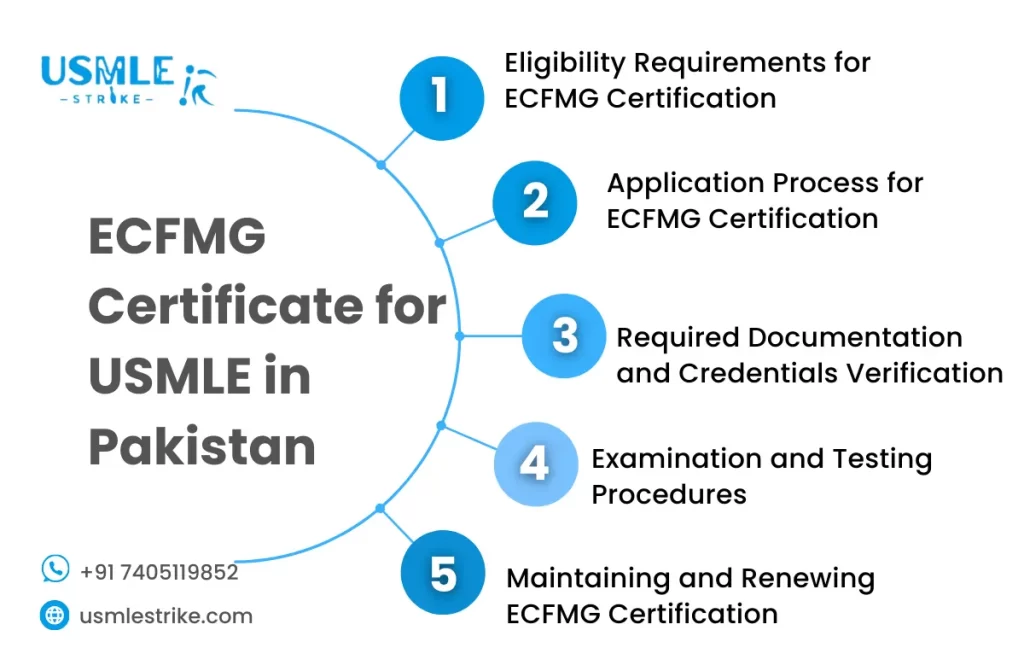
Before you can enter a US residency program, you need ECFMG Certification. This is separate from passing the USMLE Steps. It confirms to US residency programs that your medical education and credentials meet their standards.
ECFMG Certification requires:
- Passing USMLE Step 1 and Step 2 CK
- Completing the ECFMG Medical Education Credential (MEC) verification, which means having your medical school enrollment and degree verified through the MyIntealth portal
- Meeting the applicable Pathway requirements, when required, which may include requirements related to clinical and communication skills
The OET Medicine requirement. As part of ECFMG’s 2026 Pathways, applicants must achieve a satisfactory score on the Occupational English Test (OET) Medicine to satisfy the communication skills requirement. This applies to all 2026 Pathways applicants, regardless of citizenship or native language — there are no exceptions. To meet ECFMG’s requirements you need a minimum score of 350 on the Listening, Reading, and Speaking sub-tests, and 300 on the Writing sub-test, all attained in a single test administration, taken on or after January 1, 2024.
OET Medicine is a separate registration and cost from ECFMG’s own fees — the current fee is approximately $450–455 USD (around PKR 1,26,000 at ~PKR 280/USD). Budget for it alongside your ECFMG and USMLE fees, and book it early: results need to reach ECFMG in time for your Pathways application and, if you’re targeting a specific Match cycle, in time for NRMP reporting deadlines.
The ECFMG Certification process is managed through the MyIntealth portal at ecfmg.org/myintealth. Create your MyIntealth account early and start the credential verification process well before you plan to register for any exam. Credential verification requires ECFMG to contact your medical school directly, and the timeline depends on how quickly your institution responds.
ECFMG Certificates are now issued digitally through MyIntealth. Physical mail certificates are no longer the standard process.
Your medical school must be listed in the World Directory of Medical Schools (WDOMS) with a notation confirming that its graduates are eligible for ECFMG Certification. Verify this at wdoms.org before starting the process.
USMLE Registration Process for Pakistani Students in 2026
The registration process changed in January 2026. Exam registration for all three Steps now goes through FSMB, not ECFMG. This is the biggest process change in recent years and many guides still describe the old system.
Here is the correct 2026 registration process:
Step 1: Create your MyIntealth account. Go to ecfmg.org and create a MyIntealth account. This is where you begin the ECFMG certification process, submit your medical school credentials for verification, and obtain your ECFMG Identification Number.
Step 2: Submit your ECFMG Certification application. Apply for ECFMG Certification through MyIntealth and pay the certification application fee. Your application must be accepted before you can proceed to exam registration.
Step 3: Complete credential verification. Upload your medical school documents through MyIntealth for verification. ECFMG contacts your institution to confirm your enrollment and degree. Start this early as the timeline depends on your medical school’s response.
Step 4: Create your FSMB account. Go to usmle.fsmb.org and create an account. Use the exact same name and date of birth that appear on your medical credentials.
Name matching matters. Names on your PMDC/PM&DC registration, your passport, your MyIntealth account, and your FSMB account must match character-for-character — including father’s name order and spelling variations. Even minor mismatches are one of the leading causes of eligibility verification holds for Pakistani applicants. Check spelling and name order carefully against your passport before creating each account.
Step 5: Verify identity and eligibility. The FSMB system verifies your identity and ECFMG eligibility through the Intealth platform. Your ECFMG Certification application must be accepted and your identity must be matched before you can access the Step 1 or Step 2 CK applications. This is the same identity-matching process referenced above — inconsistent names across your documents are the most common cause of delays at this stage.
Step 6: Apply for your exam. Select your exam Step, choose your eligibility period (a three-month window during which you must sit the exam), and upload required documents. Choose your eligibility window carefully based on your actual preparation timeline. Changing it later involves additional fees.
Step 7: Pay the registration fee. Pay through the FSMB portal. Accepted payment methods are American Express, Mastercard, and Visa credit or debit cards. Payment must be in US dollars.
Step 8: Receive your scheduling permit. Once approved, your scheduling permit will appear in your FSMB account. Use this to book your exam date at a Prometric test centre.
Step 9: Book your Prometric date. Book as early as possible after receiving your permit. Prometric slots, especially in Pakistan, fill up well in advance.
Prometric Test Centres in Pakistan
Pakistani students can take USMLE Step 1 and Step 2 CK at Prometric test centres in Pakistan. Step 3 is only available in the United States.
Prometric-authorized USMLE test centres have been available in cities including:
- Islamabad
- Lahore
- Karachi
Islamabad is a significant option for students based in Punjab, KPK, and AJK who don’t want to travel to Lahore or Karachi.
When booking through your FSMB scheduling permit, you will be able to select your preferred centre and available date. Slots fill quickly, particularly in the months before the NRMP Match season. If you have a specific target exam date, book as soon as your permit arrives rather than waiting until you feel more prepared.
Test-centre availability can change. Check current centre locations and addresses directly at prometric.com when you are ready to book.
USMLE Fees for Pakistani Students (2026)
All fees are paid in US dollars. PKR equivalents below are calculated at approximately PKR 280 per USD as of mid-2026. Exchange rates fluctuate significantly, so verify the current rate at the time of payment.
USMLE Exam Fees
| Exam | Base Fee (USD) | International Surcharge | Total (USD) | Approx. PKR |
|---|---|---|---|---|
| FSMB identity verification fee (if required)* | — | — | $75 | approx PKR 21,000 |
| USMLE Step 1 | $695 | $210 | $905 | approx PKR 2,53,400 |
| USMLE Step 2 CK | $695 | $235 | $930 | approx PKR 2,60,400 |
| USMLE Step 3 | $955 | None (US only) | $955 | approx PKR 2,67,400 |
*This $75 fee is not a standard mandatory account-setup charge. FSMB applies it only if the system cannot identify you from the information you initially provide and additional identity-verification steps are needed. It’s issued as a one-time credit toward an eligible FSMB service, and most applicants who submit accurate, consistent information across their documents will not incur it. It is not included in the cost estimates below.
ECFMG Certification Fees (paid through MyIntealth)
| Service | Fee (USD) | Approx. PKR |
|---|---|---|
| MyIntealth Account Establishment | $110 | approx PKR 30,800 |
| Application for ECFMG Certification | $580 | approx PKR 1,62,400 |
| Credential Verification | $220 | approx PKR 61,600 |
| Pathway Application (if applicable) | $945 | approx PKR 2,64,600 |
| OET Medicine (if applicable) | ~$450–455 | approx PKR 1,26,000 |
The three core ECFMG fees (account establishment, certification application, credential verification) total $910 and apply to essentially all applicants. The Pathway Application fee and OET Medicine apply to applicants who need to meet the clinical and communication skills requirements through a 2026 Pathway — in practice, this covers most Pakistani MBBS graduates who are not already licensed to practice medicine. Verify all current fees at ecfmg.org and the OET booking page before paying.
Additional Costs to Budget For
| Cost Category | Estimated USD | Approx. PKR |
|---|---|---|
| Study resources (UWorld, First Aid, NBME) | $700 to $1,500 | PKR 1,96,000 to 4,20,000 |
| ERAS Token (for residency applications) | $185 | approx PKR 51,800 |
| NRMP Registration | $70 | approx PKR 19,600 |
| USMLE Transcript Fee | $70 | approx PKR 19,600 |
| Travel to US for Step 3 and clinical experience | Variable | Variable |
Estimated Total Journey Cost
The numbers below add up the mandatory and near-mandatory fees above. They exclude the conditional $75 FSMB fee, travel, visa costs, accommodation, and the cost of retaking any exam — all of which can add substantially to the total.
| Scenario | What’s included | Estimated Total (USD) | Approx. PKR |
|---|---|---|---|
| Steps 1–3 + ECFMG certification (with Pathway + OET) + study resources | Step 1, Step 2 CK, Step 3, ECFMG core fees, Pathway Application, OET Medicine, resources | approx $5,800 to $6,700 | approx PKR 16,24,000 to 18,76,000 |
| Above, plus ERAS/NRMP/transcript fees for residency application | All of the above + ERAS token, NRMP registration, transcript fee | approx $6,100 to $7,000 | approx PKR 17,08,000 to 19,60,000 |
| With US clinical experience and travel | All of the above + travel, accommodation, and clinical experience costs, which vary widely | often $10,000 to $20,000+ | highly variable |
These are estimates based on current 2026 fees and typical scenarios. Individual costs vary significantly based on preparation choices, number of exam attempts, whether a Pathway/OET is required, and whether US clinical experience is pursued. Build your own budget against ecfmg.org, usmle.org, and the OET booking page rather than relying solely on these figures.
Study Resources for Pakistani Students
The resource landscape for Step 1 and Step 2 CK preparation is largely the same for Pakistani and Indian students.
For Step 1, First Aid remains the central reference. UWorld is the most used question bank. Pathoma is the standard resource for pathology. AMBOSS is a strong alternative to UWorld.
For Step 2 CK, UWorld is again the primary question bank. Since Step 2 CK carries significant weight in residency applications, it deserves serious preparation investment. USMLEStrike’s Step 2 CK and Step 3 Live Review Course covers high-yield clinical topics through live instruction and is used by students from both Pakistan and India preparing for this exam.
For Step 3, dedicated CCS case practice is essential alongside MCQ preparation. Step 3 is the only exam where CCS cases form a significant part of the assessment and they require a completely different skill set from multiple-choice question practice.
What Happens After You Pass?
Passing Steps 1 and 2 CK and obtaining ECFMG Certification qualifies you to apply for US residency. Here is the sequence:
ECFMG Certification. Once you pass Step 1, Step 2 CK, and complete all credential and Pathway requirements (including OET Medicine, where applicable), ECFMG issues your certificate digitally through MyIntealth. You need this certificate to apply through ERAS.
Residency application through ERAS. The Electronic Residency Application Service opens annually in September. Your USMLE scores, ECFMG Certificate, CV, personal statement, and letters of recommendation are submitted through ERAS to programs you apply to.
NRMP Match. The National Resident Matching Program runs the Main Residency Match each March. You rank programs in order of preference and programs rank applicants. An algorithm produces matches that are announced on Match Day in mid-March.
Visa for residency. Many IMGs enter residency on a J-1 visa sponsored through ECFMG, while some programs sponsor eligible physicians for H-1B visas. The J-1 requires you to return to your home country for two years after training unless you obtain a waiver. Visa sponsorship and pathway vary by program and applicant, so Pakistani nationals should research this early and discuss it with a visa attorney familiar with Pakistani applicants before making program selection decisions, as processing requirements and timelines vary.
Step 3 during residency. Most residents take Step 3 during their first year of residency. Step 3 is required for full physician licensure in the US and can only be taken after passing Step 1 and Step 2 CK and holding a valid ECFMG Certificate.
Common Mistakes Pakistani Students Make
Following outdated registration guides. The January 2026 FSMB transition changed where you register for exams. Students who go to MyIntealth to register for exams will not find the option there. It has moved to usmle.fsmb.org.
Not starting ECFMG credential verification early. Verification requires ECFMG to contact your medical school. If your institution is slow to respond, this can delay your entire timeline. Start the MyIntealth process well before you plan to sit any exam.
Underestimating name-matching requirements. Inconsistent names across your PMDC registration, passport, MyIntealth, and FSMB accounts are a common and avoidable cause of eligibility holds. Check every document before you register.
Preparing for the old exam format. The May 2026 format changes mean Step 1 now has 14 blocks of 30 minutes and Step 2 CK has 16 blocks of 30 minutes. Practice under the new format from day one.
Leaving OET Medicine too late. OET Medicine is now a mandatory part of the 2026 Pathways for most applicants. Results take time to process and be released to ECFMG, so book it well ahead of your Pathways application deadline, especially if you’re targeting a specific Match cycle.
Underestimating the financial commitment. The total cost of the USMLE journey — including exams, ECFMG and Pathway fees, OET Medicine, resources, and residency application costs — is significantly higher than most students initially budget for. Plan the full financial picture before you start, not after.
Delaying Step 3 too long. Step 3 is required for medical licensure and many state boards have completion timelines. Taking Step 3 early in residency removes a significant administrative burden later and keeps more state licensing options open.
Conclusion
The USMLE journey from Pakistan is demanding but it is a realistic path for Pakistani MBBS graduates who plan well and prepare thoroughly. The biggest changes in recent years are that Step 2 CK now carries significant weight in residency applications, the registration process moved to FSMB in January 2026, the exam block format changed in May 2026, and OET Medicine is now a mandatory part of the ECFMG Pathways process for most applicants.
Start your ECFMG MyIntealth process early, plan your preparation timeline around the three-month eligibility window, book OET Medicine well ahead of any Pathways deadline, and treat Step 2 CK with the same seriousness that previous generations gave Step 1.
If you want a structured plan built around your specific timeline and target specialty, the USMLE Success Strategy consultation with Dr. Apurva Popat covers preparation planning, registration sequencing, and the decisions that shape your residency application.
Check out Preparing for USMLE from the USA.