

The USMLE is a three-step examination sequence required for medical licensure in the United States. For international medical graduates, commonly called IMGs, clearing all three Steps is the foundation of a US medical career. But the requirements and registration process have changed significantly in recent years, and several parts of the old process no longer apply.
This guide covers the current USMLE requirements for international students as of 2026, including eligibility, the updated registration process through FSMB, fees, required documents, and what comes after you pass.
All fees and process details are subject to change. Verify current requirements at usmle.org, ecfmg.org, and fsmb.org before registering.
What is the USMLE and Why Do IMGs Need It?
The United States Medical Licensing Examination is a joint program of the Federation of State Medical Boards (FSMB) and the National Board of Medical Examiners (NBME). It consists of three Steps:
Step 1 tests foundational basic science knowledge including anatomy, physiology, biochemistry, pathology, pharmacology, microbiology, and behavioral science. Since January 2022, Step 1 results are reported as Pass/Fail only. There is no numerical score.
Step 2 CK (Clinical Knowledge) tests your ability to apply medical knowledge in clinical settings including internal medicine, surgery, pediatrics, obstetrics and gynaecology, psychiatry, and preventive medicine. Step 2 CK is the primary USMLE numerical score available to residency programs because Step 1 is reported as Pass/Fail only.
Step 3 assesses whether you can apply medical knowledge and clinical skills in the context of unsupervised medical practice. It is a two-day exam combining multiple-choice questions and Computer-Based Case Simulations (CCS). For IMGs, Step 3 can only be taken after passing Step 1 and Step 2 CK and holding a valid, unexpired ECFMG Certificate. It is generally taken during or after the first year of residency.
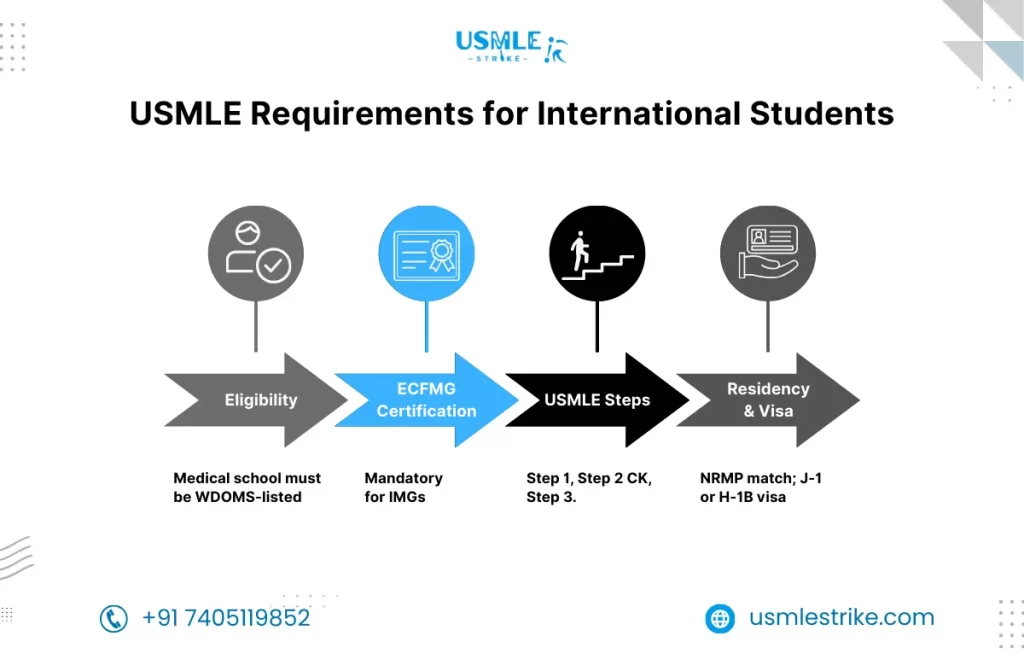
IMGs must meet ECFMG Certification requirements, including passing Step 1 and Step 2 CK and completing the applicable clinical and communication requirements, to enter an accredited US residency program. Step 3 is required for the broader physician licensing pathway and is taken after starting residency.
Who is Eligible?
To sit the USMLE as an international student, you must meet all of the following:
Medical school recognition Your medical school must be listed in the World Directory of Medical Schools (WDOMS) with a notation that its graduates are eligible for ECFMG Certification. You can verify this at wdoms.org before applying.
ECFMG Certification eligibility All IMGs must obtain ECFMG Certification before they can enter an accredited US residency program. ECFMG Certification requires passing Step 1 and Step 2 CK, completing credential verification through MyIntealth, and meeting any additional pathway requirements applicable to your situation.
Completion of your medical degree You must have completed, or be in the process of completing, your primary medical degree from a recognized institution.
No specific English proficiency test The USMLE does not require a separate English language examination. However, strong medical English is essential for exam performance and clinical practice. All exam questions are in English only.
ECFMG Certification: What It Is and Why It Matters
ECFMG Certification is a separate requirement from passing the USMLE Steps and is mandatory for IMGs before entering US residency. Do not confuse ECFMG Certification with USMLE exam registration. They are distinct processes that happen through different portals.
ECFMG Certification confirms that your medical education and credentials meet the standards required to participate in accredited US graduate medical education programs. Without it, you cannot apply to residency through ERAS or match through NRMP, regardless of your USMLE scores.
The ECFMG Certification process is managed through the MyIntealth portal at ecfmg.org/myintealth. The main requirements include:
- Passing USMLE Step 1 and Step 2 CK
- Completing the ECFMG Medical Education Credential (MEC) component, which involves verifying your medical school enrollment and degree through MyIntealth
- Meeting any applicable Pathway requirements (introduced through ECFMG’s 2023 policy changes)
The old Form 183 process that required a dean’s signature and notarization has been replaced by digital credentialing through MyIntealth. If you are using guides written before 2023, the document submission process they describe may no longer apply.
Updated USMLE Registration Process for IMGs in 2026
This is the most important section for IMGs in 2026 because the registration process changed significantly in January 2026.
Before January 2026: IMGs registered for USMLE Steps through the ECFMG portal (MyIntealth).
From January 2026: All USMLE exam registration for IMGs moved to FSMB at usmle.fsmb.org. From January 2026, IMGs use FSMB for USMLE exam services, while ECFMG and MyIntealth continue to manage ECFMG Certification and related credentialing processes.
This means if you are following a guide written before 2026, the registration steps it describes are no longer current.
Step-by-Step Registration Process for IMGs (2026)
Step 1: Complete MyIntealth setup for ECFMG Go to ecfmg.org and create your MyIntealth account. This is where you initiate the ECFMG credential verification process. You will receive your ECFMG Identification Number through this portal.
Step 2: Complete ECFMG credential verification Submit your medical school enrollment and degree documents through MyIntealth for verification. Credential verification can take time because ECFMG must obtain confirmation from your medical school, which is outside ECFMG’s direct control. Start this process well before your planned exam timeline.
Step 3: Create your FSMB account Go to usmle.fsmb.org and create an account for USMLE exam registration. Use the exact same name and date of birth that appear on your medical credentials. Even minor mismatches cause verification delays.
Step 4: Complete identity and eligibility verification The FSMB system verifies your identity and eligibility through Intealth. This requires your ECFMG Certification application to have been accepted and your identity to be matched through the Intealth system before you can access the Step 1 or Step 2 CK applications.
Step 5: Select your exam and eligibility period Choose your Step (1, 2 CK, or 3), upload required documents, and select your eligibility period. Your eligibility period is a 3-month window during which you must sit the exam. Choose it carefully based on your preparation timeline.
Step 6: Pay the registration fee Pay through the FSMB portal. All fees are non-refundable. Accepted payment methods are American Express, Mastercard, and Visa credit or debit cards in US dollars.
Step 7: Receive your scheduling permit Once approved, your scheduling permit will appear in your FSMB account. Use this to book your exam date at a Prometric test centre.
Step 8: Book your Prometric date Book your test date as soon as you receive your scheduling permit. Test centres in India fill quickly, especially during peak periods between June and September.
Documents You Need
Prepare these before starting any registration process:
- Valid passport (used as primary ID throughout the entire process)
- Medical school transcript showing your degree
- ECFMG Identification Number (obtained through MyIntealth after account creation)
- Recent passport-size photo in digital format
- Credit or debit card for fee payment (US dollars)
For ECFMG credential verification through MyIntealth you will also need official documentation from your medical school confirming your enrollment and degree. ECFMG will specify the exact documents required based on your school’s credential verification pathway.
USMLE Fees for International Students 2026
| Exam | Base Fee (USD) | International Surcharge | Total for IMGs |
|---|---|---|---|
| FSMB Account Setup | $75 | N/A | $75 |
| USMLE Step 1 | $695 | $210 (outside US/Canada) | $905 before 18% Indian GST |
| USMLE Step 2 CK | $695 | $235 (outside US/Canada) | $930 before 18% Indian GST |
| USMLE Step 3 | $955 | None (only taken in US) | $955 |
Indian candidates taking Step 1 or Step 2 CK at test centres in India should account for an additional 18% GST on top of the fees above. This is collected separately.
ECFMG-related fees (paid through MyIntealth, separate from exam fees):
- MyIntealth account establishment: $110
- Application for ECFMG Certification: $580
- Credential verification: $220
The three core ECFMG fees listed above total $910, but additional fees may apply depending on your certification pathway and services required. Candidates residing in India should also note that 18% Indian GST applies to ECFMG and MyIntealth fees paid from India, not only to exam surcharges.
All fees are subject to change. Verify current amounts at usmle.org, fsmb.org, and ecfmg.org before paying.
2026 Exam Format Changes
The USMLE changed its block format for Step 1 and Step 2 CK in May 2026. If you are using preparation guides written before this date, the block structure they describe is outdated.
Step 1 (effective May 14, 2026) 14 blocks of 30 minutes each, up to 20 questions per block, up to 280 questions total, approximately 8 hours total including breaks.
Step 2 CK (effective May 7, 2026) 16 blocks of 30 minutes each, up to 20 questions per block, up to 318 questions total, approximately 9 hours total including breaks.
Step 3 Day 1 (Foundations of Independent Practice): approximately 232 multiple-choice questions Day 2 (Advanced Clinical Medicine): approximately 180 multiple-choice questions plus Computer-Based Case Simulations (CCS cases)
Note: For IMGs, Step 3 can only be taken after passing Step 1 and Step 2 CK and holding a valid, unexpired ECFMG Certificate. Verify current Step 3 eligibility requirements at usmle.org before registering.
Preparing for the USMLE: Key Resources
Step 1 First Aid for the USMLE Step 1 is the central reference used by most students. UWorld is the most widely used question bank. AMBOSS is a strong alternative. Pathoma is the standard resource for pathology. USMLEStrike’s Step 1 Study Notes cover all high-yield subjects aligned with the First Aid structure.
Step 2 CK UWorld is again the primary question bank. Master the Boards is commonly used for systematic clinical review. Since Step 2 CK is now the most important numerical score for IMG residency applications, this step deserves significant preparation investment. USMLEStrike’s Step 2 CK and Step 3 Live Review Course covers high-yield clinical topics with live instruction from Dr. Apurva Popat.
Step 3 UWorld Step 3 QBank. Dedicated CCS case practice is essential since Step 3 includes 13 to 14 Computer-Based Case Simulations that require a different skill set from MCQ preparation.
What Comes After Passing the USMLE?
Passing Step 1 and Step 2 CK and obtaining ECFMG Certification are the requirements for entering US residency. Step 3 is required for full physician licensure and is typically taken during residency. Completing the full USMLE sequence is necessary for independent medical practice in the US but the timeline for each Step differs.
Applying to enough programs IMG match rates vary significantly by specialty, scores, US clinical experience, and application strength. Applying broadly across programs that match your profile improves your chances of receiving sufficient interview invitations. Work with a mentor or advisor to determine the right number of programs for your specific situation rather than using a generic figure. The Electronic Residency Application Service (ERAS) is the system through which IMGs apply to residency programs. Applications open annually in September. Your USMLE scores, CV, personal statement, letters of recommendation, and ECFMG Certificate are submitted through ERAS to programs you apply to.
Matching through NRMP The National Resident Matching Program (NRMP) runs the Main Residency Match each March. You submit a Rank Order List of programs and programs rank applicants. An algorithm produces stable matches that are announced on Match Day in mid-March.
Visa for residency Most IMGs enter residency on a J-1 visa sponsored through ECFMG or an H-1B visa sponsored by their residency program. The J-1 requires you to return to your home country for two years after training unless you obtain a waiver. The H-1B allows a more direct path to a green card but is less commonly available. Understanding your visa pathway before applying to programs is important for long-term planning.
State medical licensure After completing residency and passing all three USMLE Steps, you apply for a medical license through the state medical board of the state where you plan to practice. Each state has its own requirements and application process.
Common Mistakes IMGs Make
Starting ECFMG credential verification too late Verification takes 4 to 8 weeks minimum. If you plan to register for an exam in June, starting the credential process in May is too late. Begin the MyIntealth process well before your target exam window.
Using the wrong portal for registration Since January 2026, exam registration goes through FSMB, not MyIntealth. Students following old guides who go to MyIntealth for exam registration will not find the registration option there. It has been removed.
Choosing an eligibility period without checking preparation readiness Your 3-month eligibility window is a commitment. Extending it later involves additional fees and paperwork. Set your window based on a realistic assessment of when you will actually be ready to sit the exam.
Not budgeting for ECFMG fees separately The ECFMG certification fees (approximately $910 combined) are separate from the USMLE exam fees. Many students budget only for the exam fees and are surprised by the ECFMG costs.
Applying to too few residency programs IMG match rates vary significantly by specialty, scores, US clinical experience, and application strength. Applying too narrowly is one of the most common reasons IMGs go unmatched. Discuss your program list with a mentor who understands your specific profile before submitting applications.
Conclusion
The USMLE requirements for international students have changed meaningfully in recent years. ECFMG credential verification now happens digitally through MyIntealth. Exam registration for all three Steps now goes through FSMB at usmle.fsmb.org. The exam block format for Step 1 and Step 2 CK changed in May 2026. And Step 2 CK has become the most strategically important exam in the sequence since Step 1 went pass/fail.
Understanding these current requirements from the start helps you build a preparation and registration timeline that avoids delays and keeps your residency application timeline on track.
If you want a personalised plan that maps your USMLE journey to your specific background and target timeline, the USMLE Success Strategy consultation with Dr. Apurva Popat is a practical starting point. For Step 2 CK and Step 3 structured preparation, the Live and Hybrid Rapid Review Course covers the clinical reasoning and patient management skills both exams test.