

The USMLE exam pattern 2026 changed significantly in May 2026. Step 1 and Step 2 CK moved from longer 60-minute blocks to shorter 30-minute blocks, changing how you need to pace yourself on exam day. If you are using guides written before May 2026, the block structure and timing information they contain no longer reflects how the exam is actually delivered. This guide covers the current format for all three Steps as of August 2026, along with scoring, passing scores, and what each exam is actually testing.
Always verify the latest format at usmle.org before your exam date as the USMLE program updates its format periodically.
Quick Overview: USMLE Exam Pattern 2026
| Step | Focus | Format | Duration |
| Step 1 | Basic Science Knowledge | MCQs, 14 blocks of 30 mins | 1 day, 8 hours |
| Step 2 CK | Clinical Knowledge and Application | MCQs, 16 blocks of 30 mins | 1 day, 9 hours |
| Step 3 | Clinical Decision-Making and Independent Practice | MCQs plus CCS cases | 2 days |
USMLE Step 1 Exam Pattern 2026
Step 1 tests your understanding of basic medical sciences and how they apply in clinical scenarios. It is the first exam in the USMLE sequence and forms the foundation of your preparation.
Important: The Step 1 format changed on May 14, 2026. The old format of 7 blocks of 60 minutes no longer applies to exams taken on or after that date.
Subjects Covered
Key foundational science areas include: Anatomy, Physiology, Biochemistry, Pathology, Pharmacology, Microbiology, Immunology, Behavioral Science, Biostatistics and Epidemiology.
Current Format (Effective May 14, 2026)
| Feature | Detail |
| Total Blocks | 14 blocks |
| Minutes per Block | 30 minutes |
| Questions per Block | Up to 20 |
| Total Questions | Up to 280 |
| Exam Duration | Approximately 8 hours including breaks |
| Question Type | Single best answer MCQs |
Scoring
Step 1 results are reported as Pass or Fail only. There is no three-digit score. This change took effect in January 2022. The minimum passing standard is set by USMLE and reviewed periodically. Check usmle.org for the current passing standard.
Because Step 1 is reported as pass/fail, Step 2 CK has become an especially important standardized numerical measure in many residency applications, including those from IMGs.
Step 2 Clinical Knowledge (CK): USMLE Exam Pattern 2026
Step 2 CK tests your ability to apply clinical knowledge and make patient care decisions in real-world scenarios. Because Step 1 is now pass/fail, Step 2 CK is one of the primary numerical data points available to residency programs when reviewing applications.
Important: The Step 2 CK format also changed on May 7, 2026. The old format of 8 blocks of 60 minutes no longer applies to exams taken on or after that date.
Subjects Covered
Internal Medicine, Surgery, Pediatrics, Obstetrics and Gynaecology, Psychiatry, Preventive Medicine, Neurology, Emergency Medicine
Current Format (Effective May 7, 2026)
| Feature | Detail |
| Total Blocks | 16 blocks |
| Minutes per Block | 30 minutes |
| Questions per Block | Up to 20 |
| Total Questions | Up to 318 |
| Exam Duration | Approximately 9 hours including breaks |
| Question Type | Single best answer MCQs |
Scoring
Step 2 CK results are reported as a three-digit numerical score on a scale of 1 to 300. The current minimum passing score is 218, effective July 1, 2025. Higher scores can strengthen a residency application, but there is no single score that guarantees competitiveness across all specialties or programs. Applicants should evaluate their score alongside the rest of their application and the requirements of their target programs. Always verify the current passing standard at usmle.org as it is reviewed periodically.
Step 3: Final Stage of the USMLE Exam Pattern
Step 3 is the final USMLE exam and is generally taken after medical school. Many physicians take it during or after the first year of residency, although some IMGs may take it before starting residency for immigration or other professional reasons. It tests whether you can practice medicine without supervision.
Step 3 eligibility requires passing Step 1 and Step 2 CK and meeting all USMLE Step 3 eligibility requirements. IMGs must also hold a valid ECFMG Certificate.
Day 1: Foundations of Independent Practice (FIP)
| Feature | Detail |
| Total Questions | Approximately 232 MCQs |
| Total Duration | Approximately 7 hours |
| Block Structure | Multiple blocks (verify current structure at usmle.org) |
| Focus | Biostatistics, epidemiology, ethics, preventive medicine, pharmacotherapy principles |
Day 2: Advanced Clinical Medicine (ACM)
| Feature | Detail |
| MCQ Blocks | 9 blocks of 30 minutes |
| MCQ Questions | Approximately 180 questions |
| CCS Cases | 13 to 14 Computer-Based Case Simulations |
| Total Duration | Approximately 9 hours |
| Focus | Clinical decision-making across all major specialties plus patient management simulations |
Computer-Based Case Simulations (CCS)
CCS is unique to Step 3 and the part most candidates are least prepared for. Unlike MCQs where you select from options, CCS requires you to actively manage a simulated patient. You order diagnostic tests, review results, start treatment, adjust management as the case evolves, and advance the simulation clock within each case.
Key CCS tactics: order the most essential tests first rather than everything at once, advance the clock to get results, reassess the patient based on those results, and complete all follow-up actions including repeat labs, referrals, and disposition decisions before closing the case. Systematic thinking performs better than exhaustive ordering — though the exact management sequence depends on the individual case, and there is no single universally correct order for every scenario.
Scoring
Step 3 results are reported as a three-digit numerical score on a scale of 1 to 300. The current minimum passing score is 200, effective January 1, 2024. Check usmle.org for the most current passing standard as this is reviewed periodically.
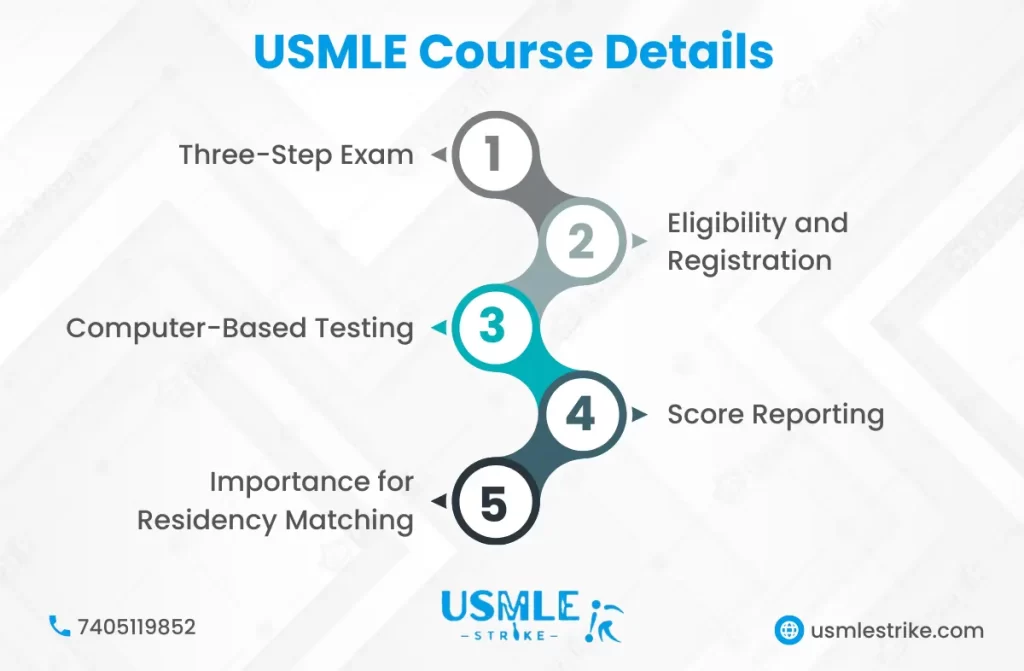
Complete USMLE 2026 Exam Pattern Summary
| Step | Format | Total Duration | Questions | Passing Score | Score Reporting |
| Step 1 | 14 blocks, 30 mins each | 1 day, ~8 hours | Up to 280 MCQs | Set by USMLE (check usmle.org) | Pass/Fail only |
| Step 2 CK | 16 blocks, 30 mins each | 1 day, ~9 hours | Up to 318 MCQs | 218 (effective July 1, 2025) | Three-digit score |
| Step 3 Day 1 (FIP) | Multiple blocks | ~7 hours | ~232 MCQs | — | Integrated into final score |
| Step 3 Day 2 (ACM) | 9 MCQ blocks + CCS | ~9 hours | ~180 MCQs + 13 to 14 CCS | 200 (effective Jan 1, 2024) | Three-digit score |
Source: usmle.org. Format details reflect changes effective May 2026. Always verify before registering, and cross-check details against the official USMLE exam pages, the USMLE 2026 software transition announcement, FSMB, and ECFMG (for IMG-specific requirements).
USMLE Attempt Limits
You may attempt each USMLE Step a maximum of four times. For the fourth attempt, specific timing restrictions apply: it must be at least 12 months after your first attempt on that Step and at least 6 months after your most recent attempt. There is no universal 60-day mandatory waiting period between all attempts. Check the current USMLE eligibility requirements at usmle.org before scheduling any attempt.
Many state medical boards also enforce a time limit, often 7 years, to complete all three Steps from passing Step 1. Individual state boards may impose stricter attempt limits than the USMLE program itself. Check the requirements of the state where you plan to seek licensure before planning your attempt strategy.
Attempts are reported on the USMLE transcript and may be considered as part of an applicant’s overall residency application.
Preparation Tips for the 2026 USMLE Exam Pattern
Adjust your pacing strategy for the new block format The shift to 30-minute blocks for Step 1 and Step 2 CK changes how you practice. Instead of training for 40 questions in 60 minutes, you now need to be comfortable completing up to 20 questions in 30 minutes. Practice timed blocks in the new format from the start of your preparation. Do not use old question bank settings that simulate the previous format.
Start questions earlier than you think you need to The 30-minute block format increases time pressure per question. Students who have only ever done untimed or 60-minute practice blocks often find the new pacing disorienting on exam day. Timed practice from day one builds the pacing instincts you need.
Use self-assessments on a schedule Take a baseline NBME self-assessment early in your preparation regardless of how underprepared you feel. This shows you exactly where your weak areas are before you have spent weeks studying the wrong things. Reassess every 3 to 4 weeks and redirect your study time based on the data, not on personal preference.
Prepare for CCS specifically if you are targeting Step 3 Most general preparation resources cover MCQs well but give minimal guidance on CCS strategy. CCS requires a different skill set from MCQs. Work through guided CCS case practice before your exam date, not as an afterthought in the final week.
Make Step 2 CK a preparation priority Since Step 1 is now pass/fail, Step 2 CK is one of the primary numerical scores available to residency programs when reviewing IMG applications. Invest preparation time proportional to that weight. The minimum passing score is 218, and a strong score well above that minimum improves your application across most specialties.
How USMLEStrike Supports Your Preparation
For Step 2 CK and Step 3, USMLEStrike’s Step 2 CK and Step 3 Live and Hybrid Rapid Review Course is built around the clinical reasoning and patient management skills that both exams test. The course includes 600+ board-style questions, live sessions with Dr. Apurva Popat, annotated e-notes, and dedicated CCS case walkthroughs for Step 3.
For Step 1 preparation, the Ultimate USMLE Step 1 Study Notes cover all high-yield subjects aligned with the First Aid structure.
If you want a personalised plan that maps your preparation timeline to your target exam dates and residency goals, the USMLE Success Strategy consultation with Dr. Apurva Popat is the right starting point.