Skip to content
About Us
Who is Dr. Apurva Popat?
Courses
USMLEStrike Dicounts
Services
Residency Match Essentials
USMLE Step 2CK/3 Live/Hybrid Rapid Review Course
Topics
Blog
Web Stories
Podcast
Contact Us
Testimonials
About Us
Who is Dr. Apurva Popat?
Courses
USMLEStrike Dicounts
Services
Residency Match Essentials
USMLE Step 2CK/3 Live/Hybrid Rapid Review Course
Topics
Blog
Web Stories
Podcast
Contact Us
Testimonials
About Us
Who is Dr. Apurva Popat?
Courses
USMLEStrike Dicounts
Services
Residency Match Essentials
USMLE Step 2CK/3 Live/Hybrid Rapid Review Course
Topics
Blog
Web Stories
Podcast
Contact Us
Testimonials
Search
Search
Antibodies
Antibody-Dependent Cell-Mediated Cytotoxicity (ADCC)
Antigen Processing and Presentation
Antihypertensive Therapy
Apolipoproteins
Asplenia
Ataxia-Telangiectasia
Atherosclerosis
Atrial Arrhythmias
Atrial Septal Defects
Atrioventricular (AV) Heart Block
Biochemistry
Cardiovascular
Dermatology
Embryology
Endocrine
Gastrointestinal
Hematology
Immunology
Microbiology
MSK
Neurology
Oncology
Pathology
Pharmacology
Psychiatry
Renal
Reproductive
Respiratory
Stats
Anatomy
Antibodies
Antibody-Dependent Cell-Mediated Cytotoxicity (ADCC)
Antigen Processing and Presentation
Antihypertensive Therapy
Apolipoproteins
Asplenia
Ataxia-Telangiectasia
Atherosclerosis
Atrial Arrhythmias
Atrial Septal Defects
Atrioventricular (AV) Heart Block
Biochemistry
Cardiovascular
Dermatology
Embryology
Endocrine
Gastrointestinal
Hematology
Immunology
Microbiology
MSK
Neurology
Oncology
Pathology
Pharmacology
Psychiatry
Renal
Reproductive
Respiratory
Stats
Anatomy
Antibodies
Antibody-Dependent Cell-Mediated Cytotoxicity (ADCC)
Antigen Processing and Presentation
Antihypertensive Therapy
Apolipoproteins
Asplenia
Ataxia-Telangiectasia
Atherosclerosis
Atrial Arrhythmias
Atrial Septal Defects
Atrioventricular (AV) Heart Block
Biochemistry
Cardiovascular
Dermatology
Embryology
Endocrine
Gastrointestinal
Hematology
Immunology
Microbiology
MSK
Neurology
Oncology
Pathology
Pharmacology
Psychiatry
Renal
Reproductive
Respiratory
Stats
Anatomy
Hypospadias / Epispadias
Home
-
Topics
-
Hypospadias / Epispadias
Introduction
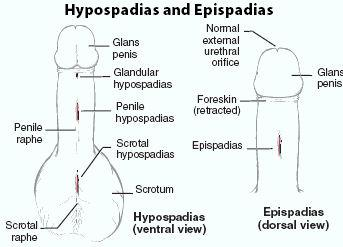
Embryological malformations of the urethra (urethral groove)
may involve the urethral folds or genital tubercle
Two main types
epispadias
urethra opens on dorsal surface of penis
urine goes ↑
defect in the genital tubercle
hypospadias
urethra opens on ventral surface of penis
urine goes ↓
defect in closure of urethral folds
secondary to abnormal androgen production
associated with a ventral curvature of the penis (chordee)
risk factors
monozygotic twins
potential association with in-vitro fertilization (IVF)